Which years and versions
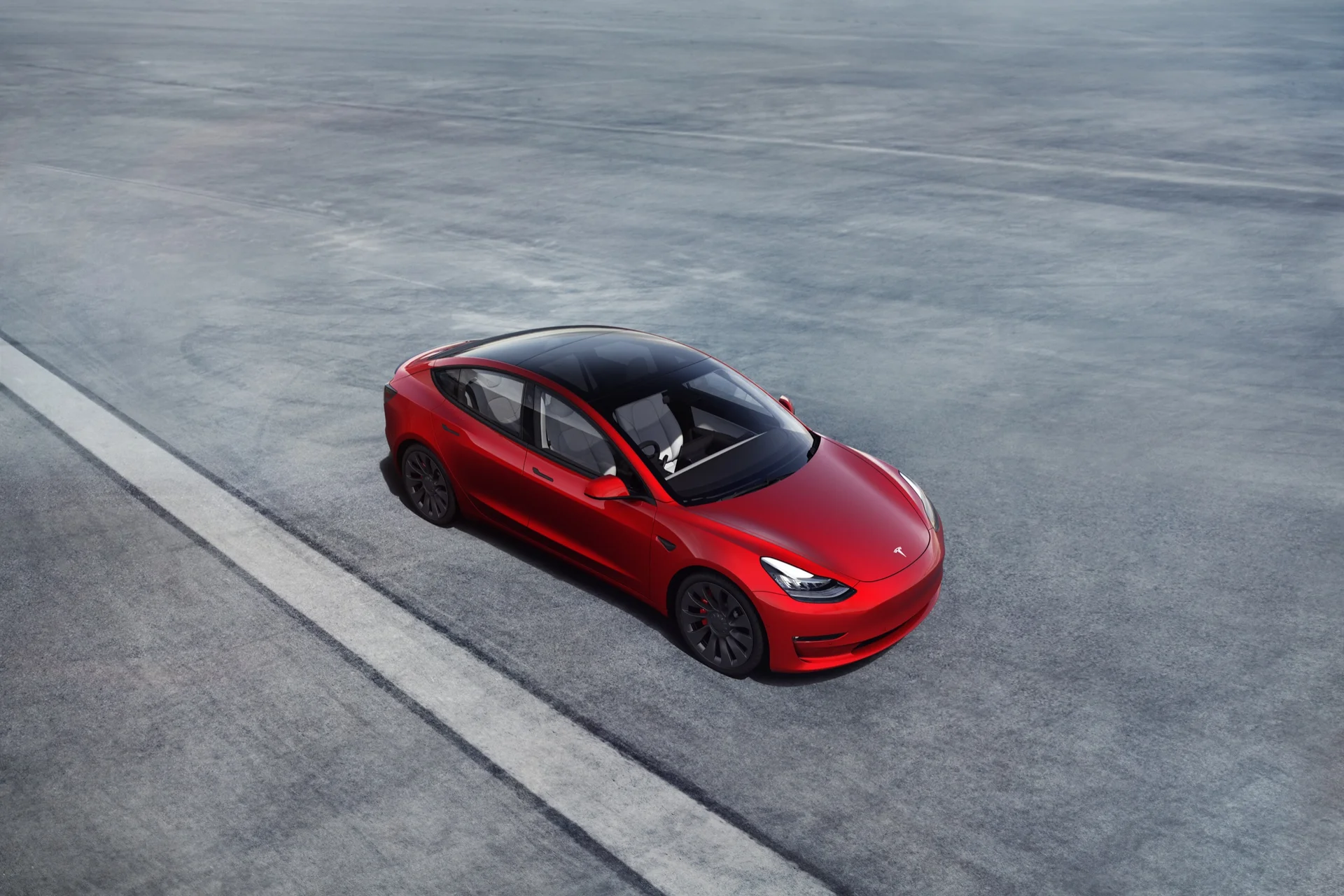
European deliveries started in early 2019 with three versions: the Standard Range Plus (rear-wheel drive, the cheapest), the Long Range with a motor on each axle, and the Performance, which added bigger wheels, lowered suspension and a 261 km/h top speed. All three share the same body, cabin and 15-inch centre screen.
The first big update arrived at the end of 2020, for the 2021 model year. It's the most important dividing line in the used market, because it brought a heat pump, which uses far less energy to warm the cabin than the old resistive heater. That matters most in winter, when early cars lose a lot of range to heating. The same update added a powered boot lid, black trim in place of the chrome, a redesigned centre console with two wireless phone chargers, auto-dimming door mirrors and new wheel designs. The Performance also got a bigger battery.
Around the same time, Tesla started supplying Europe from its Shanghai factory instead of California. The quickest way to tell where a car was built is the VIN: Californian cars start with 5YJ, Shanghai cars with LRW. Some 2021 Standard Range Plus cars from Shanghai used an LFP (lithium iron phosphate) battery, while others kept the older nickel-based cells.
In late 2021 the Standard Range Plus was replaced by the RWD, with a larger LFP battery, and heated rear seats and a heated steering wheel became standard on the cheapest version. The Long Range moved to a Shanghai-built battery and was rated at 602 km (374 miles), the highest figure any pre-facelift Model 3 achieved.
How to tell a pre-facelift car from the new one
The Highland facelift reached European customers in late 2023, so 2023-registered cars can be either version. The facelift is easy to spot: it has slimmer headlights with no separate front fog lights, C-shaped tail lights, an ambient light strip across the dashboard and a screen for rear passengers. Its first cars also had no indicator or gear stalks behind the steering wheel. If a 2023 car has stalks, fog lights and the older, rounder headlights, it's the original model.
Battery, range and charging
How a battery has been treated matters more than its age. Tesla's 2023 Impact Report put the average capacity loss of Model 3 and Model Y Long Range batteries at about 15% after 200,000 miles (about 320,000 km), and most used cars have covered a fraction of that. Our article on how long electric car batteries last covers the wider evidence.
The two battery types need different habits. Tesla recommends charging LFP cars to 100% at least once a week, and the car's charging screen says so, which is also a simple way to confirm a car has an LFP battery. Nickel-based batteries are happier kept at 80-90% for daily driving. An LFP car that has regularly been charged to 100% has been treated correctly; a Long Range that lived at 100% has not.
The best check is Tesla's own Battery Health Test. On cars with recent software, it's under Controls, Service, Battery Health Test. The car has to be plugged into an AC charger, the test can take up to 24 hours and it runs the battery down below 10%, so ask the seller to run it before your viewing rather than expecting to do it on the day.
At a rapid charger, the RWD peaks at 170 kW and the Long Range and Performance at 250 kW on a Tesla Supercharger. Every version takes 11 kW from a home or public AC charger.
Warranty
The warranty stays with the car, which makes a used Model 3 an easier buy than many older EVs. In Europe the battery and drive unit are covered for eight years, with at least 70% of the battery's capacity guaranteed:
- Standard Range Plus and RWD: eight years or 160,000 km (100,000 miles in the UK)
- Long Range and Performance: eight years or 192,000 km (120,000 miles in the UK)
So even a 2019 car keeps its battery cover until 2027, as long as it's under the mileage limit. The basic warranty, covering everything else, runs for four years, so it has expired on most pre-facelift cars. A used Model 3 bought from Tesla itself comes with an extra year of cover under Tesla's Used Vehicle Limited Warranty, on top of the remaining battery warranty.
Common problems and recalls
The drivetrain has a good record, and owners in UK satisfaction surveys rate the motors, running costs and infotainment highly. Build quality is the weak spot: the same surveys put the Model 3 near the bottom for interior and exterior quality and for ride comfort.
Germany's TÜV inspections tell a similar story. In the TÜV Report 2026, 13.1% of two-to-three-year-old Model 3s failed their first inspection with a significant fault, near the bottom of the 110 models ranked, and the Model 3 had been last in that age group in the two previous reports. Among six-to-seven-year-old cars, the failure rate was 21.0%. TÜV points to suspension parts, which carry the weight of a heavy battery, brake discs, which rust because regenerative braking does most of the work, and lights. Tesla's lack of fixed service intervals means many cars aren't checked by a workshop between inspections, which TÜV says doesn't help. To be fair to the Model 3, these cars also arrive at their first inspection with high mileages, about 56,000 km on average.
There have been several recalls. Early-2020 builds included a handful of cars with a missing steering column bolt, and 2021 recalls covered brake caliper bolts, seatbelts, front suspension bolts and an airbag fault. In 2022 there were recalls for rear camera wiring that could chafe and short-circuit, eCall software and a speedometer display glitch. Many were fixed by over-the-air software updates. In the UK, check a car's registration on the GOV.UK recall checker; elsewhere, Tesla service can confirm what's been done, by VIN.
What to check before you buy
- Panel gaps and paint. Look along the doors, boot and bonnet for uneven gaps, and check the paint for chips. Early cars in particular weren't well finished.
- Water leaks. Lift the boot floor and check for damp, and look at the door seals. The 2021 update added a gutter to stop water dripping into the boot.
- Glass roof and rear screen. Check for cracks.
- Suspension. Listen for knocks or clunks over bumps, which usually point to worn suspension arms.
- Brakes. Look for rust on the brake discs; it's common on EVs that rarely use their brakes hard.
- Tyres. Check the tread across the whole width: uneven wear can mean the alignment is out, often after a knock to the suspension.
- Battery health. Ask for the Battery Health Test result, and look at the range the car shows at 100%.
- Charging. Try it on an AC charger and, if you can, a rapid charger.
- Recalls and software. Check the recall status and make sure the car is on current software.
- The handover. Make sure the seller removes the car from their Tesla account, so you can add it to yours, and that you get both key cards.
Running costs and tax
Tesla doesn't set an annual service. Instead, the owner's manual lists a few jobs by time, such as replacing the cabin air filter, checking the brake fluid and replacing the air-conditioning desiccant bag, so ask for receipts for those.
In the UK, electric cars registered between April 2017 and March 2025 pay the standard rate of vehicle tax, £200 a year. The expensive car supplement only applies to electric cars registered from April 2025, so a Long Range or Performance doesn't pay it, even though both cost more than £40,000 new.
In Ireland, a car that's already registered here has paid its VRT, but an import pays it when it's first registered here, based on Revenue's valuation of the car. Electric cars get relief of up to €5,000 at that point, used imports included, reduced for cars Revenue values above €40,000 and none above €50,000. The relief applies to cars registered before the end of 2026, and Budget 2027 extends it to the end of 2028, subject to EU approval (see our article on VRT relief for electric cars). The SEAI grant, on the other hand, is for new cars only. Because these cars were built in the US or China, not the UK, a private import from Great Britain also pays customs duty and 23% VAT on arrival. Get the full cost before you buy.
Prices
The surprise in the adverts is how little extra a Long Range costs. In every market, asking prices for Long Range and Standard Range Plus or RWD cars of the same age overlap, so the year and the mileage move the price more than the version does. The cheapest way in is a high-mileage 2019 or 2020 car, without the heat pump.
| Version (2019-2023) | Ireland | Germany | Netherlands | France | UK |
|---|
| Standard Range Plus / RWD | €15,000-€30,000 | €24,000-€30,000 | €18,000-€30,000 | €22,000-€30,000 | £12,000-£23,000 |
| Long Range | €19,000-€30,000 | €24,000-€31,000 | €22,000-€30,000 | €22,000-€33,000 | £10,000-£24,000 |
| Performance | Few for sale | €25,000-€36,000 | €22,000-€25,000 | €22,000-€35,000 | £17,000-£27,000 |
(Rough asking-price ranges from dealer and private listings, November 2026. Mileage, condition and how you pay, whether a trade-in, finance or cash, can all move the final price. Irish prices are for cars already registered in Ireland; UK prices leave out the cost of importing, covered under Running costs and tax.)
Alternatives
If you'd like something with a hatchback, look at the Polestar 2. It's a similar size and age, and has a proper tailgate and more physical controls, though its range and charging speed fall short of a Long Range Model 3.
The Hyundai Ioniq 6, on sale from 2022, is a newer alternative with 800-volt charging that's faster than any pre-facelift Model 3 on a suitable charger. Read our review of the latest Hyundai Ioniq 6.
The Kia EV6 offers the same fast charging in a more practical crossover body; see the current Kia EV6 specs.
The best years to buy
For most buyers, the 2022-2023 RWD makes the most sense. It has the heat pump, the bigger LFP battery, 491 km (305 miles) of WLTP range and a battery you can charge to 100% every day without worry.
If you cover long distances, the Long Range from the same years is worth the extra: 602 km (374 miles) of WLTP range, faster charging and all-wheel drive. Avoid a pre-2021 car unless the price reflects the missing heat pump and the shorter range. The Performance is very fast, but it can't tow, and its lowered suspension and 20-inch wheels won't help the ride.
FAQs
Is a used Tesla Model 3 a good buy?
Yes, if you choose carefully. The drivetrain and batteries have a good record and the battery warranty lasts eight years, but build quality varies, and suspension and brake faults are common at inspections, so check the car properly.
How long do Tesla Model 3 batteries last?
Tesla's data shows Model 3 and Model Y Long Range batteries keep about 85% of their capacity on average after 200,000 miles (about 320,000 km). The battery is also guaranteed to keep at least 70% of its capacity for eight years.
Which Model 3 years have a heat pump?
Cars built from the end of 2020, sold as the 2021 model year, have a heat pump. Earlier cars use a less efficient resistive heater.