Which years and versions
The first European cars arrived in the summer of 2021: left-hand-drive Long Range and Performance models built in Shanghai. Right-hand-drive cars for the UK and Ireland followed in early 2022, and Tesla's Berlin factory began building Model Ys for Europe in 2022 too. Nearly every car has the same core kit: a heat pump, a glass roof, double-glazed side windows, heated seats and steering wheel, a premium sound system and two wireless phone chargers. That makes the version and the year far more important than the trim when you're comparing cars.
The RWD joined the range in the summer of 2022. It's the cheapest version, with a single motor and an LFP (lithium iron phosphate) battery. The Long Range has a motor on each axle and the biggest range, and the Performance adds more power, bigger wheels and lower suspension, at the cost of some range.
The most useful change for used buyers came in early 2023, when the RWD and Long Range got softer, more comfortable suspension. Ride comfort was one of the main complaints about the early cars, and owners in UK satisfaction surveys still rated the Model Y poorly for it. In late 2024, a Long Range RWD replaced the RWD in some markets, pairing the big battery with a single motor.
How to tell a pre-facelift car from the new one
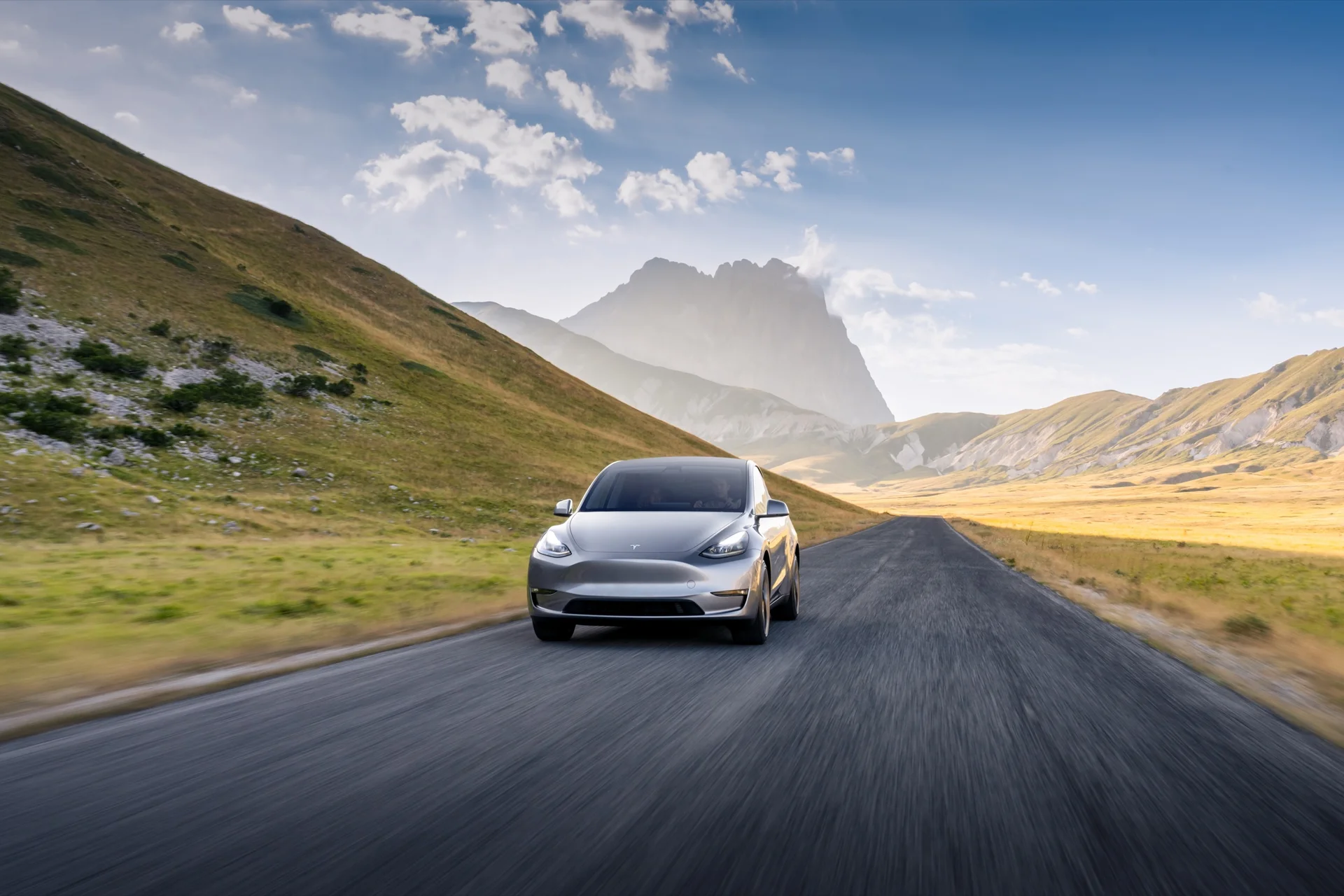
The facelift reached European customers from early 2025, so 2025-registered cars can be either version. The new car is easy to recognise: it has a light bar across the full width of the nose and the tailgate, slimmer headlights, and a screen for rear passengers. The original has separate, larger headlights and conventional tail lights.
Battery, range and charging
Tesla's 2023 Impact Report put the average capacity loss of Model 3 and Model Y Long Range batteries at about 15% after 200,000 miles (about 320,000 km), so a typical used car's battery has plenty of life left. Our article on how long electric car batteries last covers the wider evidence.
The RWD's LFP battery and the Long Range's nickel-based battery need different habits. Tesla recommends charging LFP cars to 100% at least once a week, while nickel-based batteries are better kept at 80-90% for daily use. An RWD that has been charged to 100% regularly has been looked after properly.
The best check is Tesla's Battery Health Test, found under Controls, Service, Battery Health Test on cars with recent software. The car has to be plugged into an AC charger, and the test can take up to 24 hours and runs the battery below 10%, so ask the seller to run it before you visit.
The RWD charges at up to 170 kW and the Long Range and Performance at up to 250 kW on a Tesla Supercharger. Every version takes 11 kW from an AC charger. Expect a lot less range in winter: as with any EV, cold weather and motorway speeds cut it noticeably.
Space and practicality
This is where the Model Y earns its sales figures. The boot holds 854 litres to the roof with the rear seats up, and there's a 117-litre front boot under the bonnet for charging cables. Rear seat space is generous, and every version is rated to tow a 1,600 kg braked trailer, which few EVs of this age can match.
Warranty
The battery and drive unit warranty stays with the car, and every pre-facelift Model Y is still well within its eight years. In Europe, the battery is guaranteed to keep at least 70% of its capacity:
- RWD: eight years or 160,000 km (100,000 miles in the UK)
- Long Range and Performance: eight years or 192,000 km (120,000 miles in the UK)
The four-year basic warranty, covering everything else, has run out on the earliest cars and will run out on most 2022 cars during 2026. A used Model Y bought from Tesla adds a year of cover under Tesla's Used Vehicle Limited Warranty, on top of the remaining battery warranty.
Common problems and recalls
The motors and batteries have a good record. The problems are elsewhere. In the TÜV Report 2026, which covers Germany's mandatory inspections, the Model Y came last of 110 models in the two-to-three-year-old group: 17.3% failed with a significant fault, the highest figure in that age group for ten years. TÜV highlights the axle suspension, brake discs and lights. It points out that heavy batteries wear suspension parts and that regenerative braking leaves brake discs to rust, and Tesla's lack of fixed service intervals means many cars aren't checked between inspections. The Model Ys tested had covered about 55,000 km on average, more than most cars of that age.
UK owners give a similar picture in satisfaction surveys: top marks for safety systems, infotainment and space, low marks for build quality, ride and the lack of physical buttons.
Recalls have mostly been about electrics and software. Late-2021 cars were recalled for suspension parts that weren't tightened properly at the factory. Later recalls covered eCall software (2022), tyre pressure monitoring (2024, fixed by software), the rear camera and the steering (2025), electric window motors (2025) and reversing lights (2025). In the UK, check the registration on the GOV.UK recall checker; elsewhere, Tesla service can confirm a car's recall status by VIN.
What to check before you buy
- Suspension. Drive over rough roads and listen for knocks, which point to worn suspension arms.
- Brakes. Check the discs for rust and pitting, a common inspection failure.
- Lights. Check every light, including the reversing lights.
- Build quality. Look at panel gaps, trim and door seals, and check the boot floor for damp.
- Electrics. Test the cameras, windows, screen and every button, given the recall history.
- Battery health. Ask for the Battery Health Test result and look at the range shown at 100%.
- Charging. Make sure a car charges at its rated speed: up to 170 kW for the RWD and 250 kW for the others.
- Tyres. Check for uneven wear, especially on the heavier all-wheel-drive versions.
- Tow bar. If you need one, check it's Tesla's own and that it's working.
- Paperwork. Check the recall status and ask the seller to remove the car from their Tesla account so you can add it to yours.
Running costs and tax
Tesla sets no annual service. The owner's manual lists a few time-based jobs instead, such as the cabin air filter and a brake fluid check, so ask for receipts.
In the UK, electric cars registered between April 2017 and March 2025 pay the standard rate of vehicle tax, £200 a year, with no expensive car supplement. The supplement only applies to electric cars registered from April 2025 with a list price over £50,000, which could catch a late Performance registered after that date.
In Ireland, a car that's already registered here has paid its VRT, but an import pays it when it's first registered here, based on Revenue's valuation of the car. Electric cars get relief of up to €5,000 at that point, used imports included, reduced for cars Revenue values above €40,000 and none above €50,000. The relief applies to cars registered before the end of 2026, and Budget 2027 extends it to the end of 2028, subject to EU approval (see our article on VRT relief for electric cars). The SEAI grant, on the other hand, is for new cars only. Because the Model Y was built in China or Germany, not the UK, a private import from Great Britain also pays customs duty and 23% VAT. Work out the total before you commit.
Prices
Version matters less than you might expect. A high-mileage 2021 or 2022 Long Range is often advertised for less than a newer RWD, so it's worth comparing the two at the same budget. Performance prices vary the most: some are advertised below a Long Range of the same age, others several thousand above one.
| Version (2021-2024) | Ireland | Germany | Netherlands | France | UK |
|---|
| RWD | €25,000-€33,000 | €29,000-€35,000 | €26,000-€33,000 | €29,000-€34,000 | £18,000-£28,000 |
| Long Range | €24,000-€37,000 | €25,000-€40,000 | €28,000-€40,000 | €32,000-€37,000 | £19,000-£35,000 |
| Performance | €29,000-€41,000 | €35,000-€38,000 | €36,000-€38,000 | €26,000-€35,000 | £25,000-£36,000 |
(Rough asking-price ranges from dealer and private listings, November 2026. Mileage, condition and how you pay, whether a trade-in, finance or cash, can all move the final price. Irish prices are for cars already registered in Ireland; UK prices leave out the cost of importing, covered under Running costs and tax.)
Alternatives
If you can live without the Tesla Supercharger network, the Skoda Enyaq is a strong alternative of the same age, with a big boot and more physical controls. See the current Skoda Enyaq specs.
The Kia EV6 charges faster than any pre-facelift Model Y on an 800-volt charger, though its boot is much smaller. See the current Kia EV6 specs.
If you don't need an SUV, a Model 3 of the same age shares much of the Model Y's hardware, uses less energy and does better at inspections: 13.1% of two-to-three-year-old Model 3s failed TÜV's test, against 17.3% of Model Ys. Read our used Tesla Model 3 buying guide.
Which version to buy
For most families, a Long Range built from 2023 onwards is the one to find. It has the softer suspension, the bigger battery, all-wheel drive and 533 km (331 miles) of WLTP range, and its battery is covered until 2031.
On a tighter budget, a 2023 or later RWD has the same suspension and space, and its LFP battery can be charged to 100% every day, though its range is shorter. The Performance is very fast, but its firmer suspension and bigger wheels make it the least comfortable choice.
FAQs
Is a used Tesla Model Y reliable?
The motors and batteries have a good record, but the Model Y fails German inspections more often than any other car of its age, mostly for suspension, brake disc and lighting faults. Check those carefully, or have the car inspected, before you buy.
Can a Tesla Model Y tow?
Yes. Every pre-facelift version, including the Performance, is rated to tow a 1,600 kg braked trailer.
What's the difference between the Model Y RWD and Long Range?
The RWD has one motor, a 57 kWh LFP battery and 455 km (283 miles) of WLTP range. The Long Range has two motors, all-wheel drive, a 75 kWh battery and 533 km (331 miles), and it charges faster.