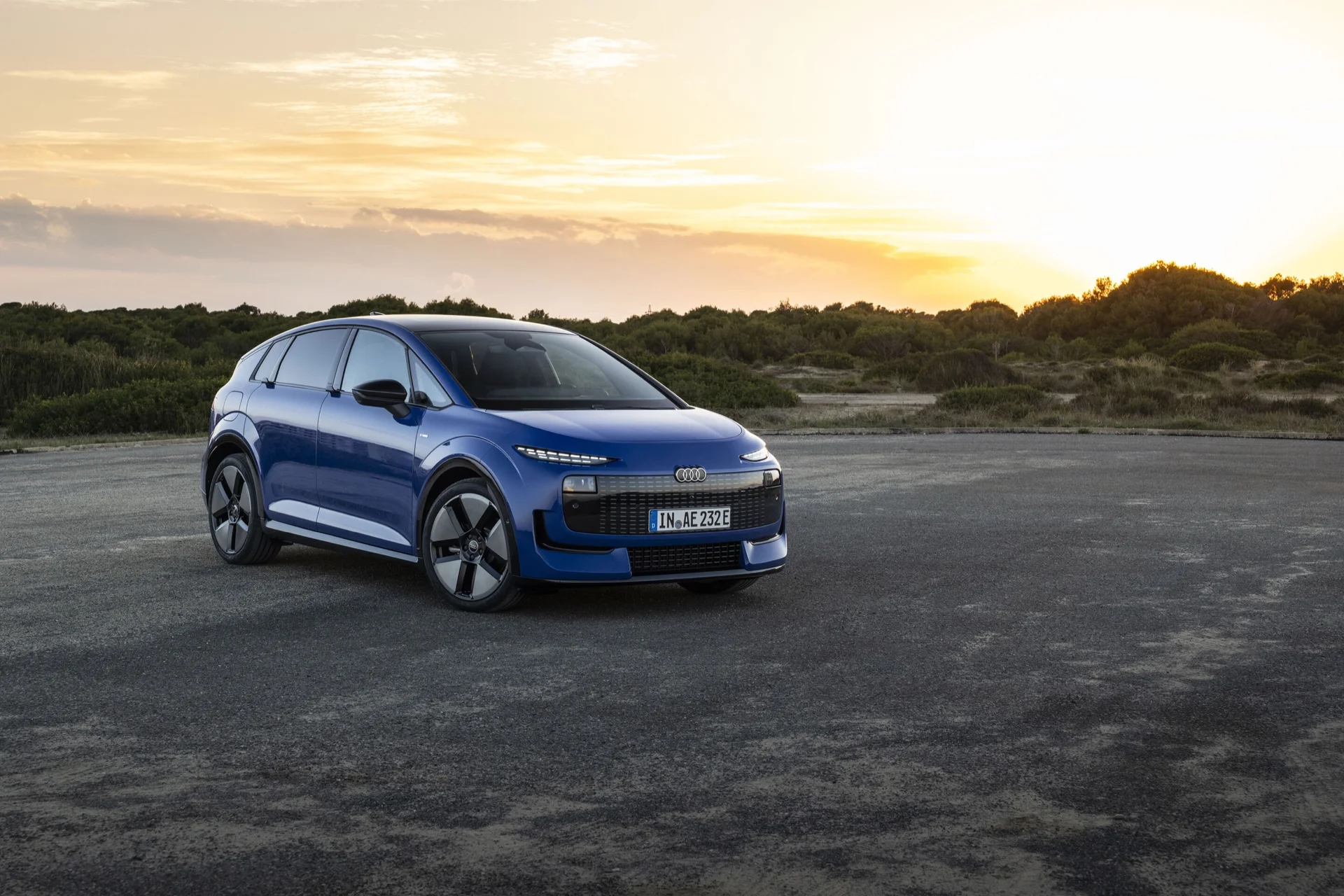
Prices and trims
| Market | Price from |
|---|
| Germany | €38,200 |
| Ireland | Not yet priced |
| UK | £32,200 |
(Prices correct at 23 November 2026. List prices before grants; the UK price is on the road. Grants may apply: the 125 kW and 140 kW versions qualify for the £1,500 Electric Car Grant in the UK. Delivery and dealer charges may be extra.)
In Germany, the 125 kW costs €38,200, the 140 kW €41,900, the 170 kW €48,900 and the 240 kW €51,200. Orders opened in September 2026, and the first cars reach Audi dealers in Europe from December. Irish prices haven't been announced yet.
The UK gets four trims. Technik starts at £32,200, or £30,700 with the grant. Sport costs from £34,800 and S line from £37,400, with the S line adding a sportier body kit with bigger bumpers, gloss black side skirts and window trim, a diffuser and extra front air intakes. Edition 1 is only offered with the 79 kWh battery, from £48,350, and adds 20-inch wheels, Matrix LED headlights, electric seats, acoustic glass for the side windows and a 360-degree camera.
The standard kit is generous for a small car. Every A2 e-tron gets adaptive cruise control, a reversing camera, parking sensors, emergency brake assist, swerve assist and side assist with exit warning, plus the MMI panoramic display with an 11.9-inch digital instrument panel and a 12.8-inch curved touchscreen.
Battery, range and charging
The A2 e-tron's range comes from efficiency rather than battery size. The two cheaper versions use LFP batteries of 52 and 61 kWh gross (50 and 58 kWh usable), built in a cell-to-pack design that saves space. Audi says the LFP cells keep performing well at low charge and in cold weather. The faster two share an 84 kWh gross (79 kWh usable) NMC battery.
The 140 kW is the efficiency champion. With the optional efficiency package, which includes sport suspension, it's rated at 12.8 kWh/100 km and goes up to 515 km on 58 kWh. That's less energy per kilometre than any Audi before it. The 170 kW goes furthest of all, up to 646 km (401 miles), while the more powerful 240 kW manages 630 km.
Charging speeds follow the batteries. The LFP versions peak at 100 kW and 105 kW, which is only average, but because the batteries are small they still go from 10-80% in 24 and 26 minutes. The NMC battery takes up to 183 kW and charges from 10-80% in 29 minutes. All versions have an 11 kW AC on-board charger for home and destination charging.
Audi's e-tron route planner plans charging stops around traffic, hills and charger availability, and warms the battery on the way so it charges at full speed. You can also choose how long each stop lasts, and the smart range manager can suggest a slightly lower cruising speed to save a stop.
The A2 e-tron can also supply power, as an option. Vehicle-to-load works from a socket in the boot or an adapter in the charging port, so you can charge an e-bike or run a laptop from the car. In Germany, Austria and Switzerland, it can power your home through a compatible DC wallbox (vehicle-to-home), but only between 20% and 80% charge.
Performance
Every A2 e-tron is rear-wheel drive, with a permanent-magnet motor at the back and silicon carbide power electronics that cut energy losses. The 125, 140 and 170 kW versions use Audi's APP350 motor, all with 350 Nm of torque, and take 8.8, 7.9 and 7.0 seconds to reach 100 km/h. All three are limited to 160 km/h, which is low for an Audi but only really matters on unrestricted German autobahns.
The 240 kW uses the bigger APP550 motor, with 545 Nm. It reaches 100 km/h in 5.7 seconds and goes on to 200 km/h, which makes it a properly quick small car.
Driving and comfort
Audi offers comfort suspension as standard, with sport suspension and stiffer anti-roll bars as an option on some versions. Suspension with damper control, which adjusts each damper continuously, is an option on the 170 kW and standard on the 240 kW. The 140 kW's efficiency package also brings the sport suspension.
There are four drive modes: comfort, balanced, efficiency and dynamic. With damper control, the car tightens its body control as you move towards dynamic. Paddles on the steering wheel select three levels of regeneration, from gentle to strong, and moving the gear selector to B gives one-pedal driving that brings the car to a stop. Normal steering is linear; progressive steering, which quickens as you turn the wheel further, is part of the Tech plus package and standard on the 240 kW.
Wheels run from 18 to 20 inches, with tyres 225 to 235 mm wide. Audi says the 19-inch aero wheels are the most efficient setup and the best balance of comfort and grip, while the 20-inch wheels are the sportier choice.
Size and practicality
At 4.32 m long and 1.79 m wide without mirrors, the A2 e-tron has a long 2.77 m wheelbase for its size, with short overhangs, and Audi says the slim LFP batteries improve legroom and the seating position. The boot holds 396 litres, rising to 1,336 litres with the rear seats folded, and the 170 kW and 240 kW versions add a small 13-litre frunk.
The details are clever. Audi is the first premium carmaker to fit Fidlock magnetic mounts as standard, so the cup holder and accessories click into place in the centre console, and three more mounts are optional in the boot. Moving the gear selector to the steering column frees up space in the console for a cooled wireless charging tray that takes two phones at 25 watts each. The front door pockets hold 1.25-litre bottles, and the console takes 1.5 litres.
Tech and equipment
The MMI panoramic display pairs the 11.9-inch Audi virtual cockpit plus with a 12.8-inch curved touchscreen, angled towards the driver. An augmented-reality head-up display is optional. The Audi assistant uses AI language models in the cloud for more natural voice control, and can answer questions about the car from the owner's manual. A "connected work" option brings Microsoft Outlook and Teams into the car.
Inside, a soft fabric covering Audi calls the Softwrap runs from the dashboard across the doors and into the back. A 1.6-square-metre panoramic glass roof is optional. Seven speakers come as standard, with an eight-speaker Audi system and a 14-speaker Sonos system as options.
Driver assistance is strong for the class. Adaptive cruise control is standard and can adjust your speed for limits, bends and junctions. The optional adaptive cruise assist plus adds lane guidance at up to 210 km/h and can stop the car at red lights, and Audi says it will soon change lanes on the motorway when you indicate. Park assist plus, a trained parking feature that remembers up to five manoeuvres, and parking from your phone are all on the options list.
Safety
The A2 e-tron hasn't been crash-tested by Euro NCAP yet. Its standard safety kit includes front emergency braking that works at up to about 85 km/h, swerve assist between 30 and 150 km/h, front cross-traffic assist, attention assist and emergency assist, which stops the car and calls for help if the driver doesn't respond.
Rivals
| Car | Price from (Germany) | Battery | WLTP range | 10-80% | Boot |
|---|
| Audi A2 e-tron 125 kW | €38,200 | 50 kWh | 423 km | 24 min | 396 litres |
| Volkswagen ID.3 Neo 50kWh | €33,995 | 50 kWh | 417 km | 24 min | 385 litres |
| Nissan Leaf 52kWh | €35,950 | 52.9 kWh | 451 km | 35 min | 437 litres |
| Toyota C-HR+ 57.7kWh | €41,990 | 54 kWh | 458 km | 28 min | 416 litres |
(German list prices before grants, correct at 23 November 2026. Usable battery capacity.)
The Volkswagen ID.3 Neo uses the same MEB technology and is €4,205 cheaper, with almost the same range and the same charging time. The Audi counters with premium touches such as the Softwrap trim, standard Fidlock mounts and the Sonos sound option.
The Nissan Leaf goes a little further on a similar battery and has a bigger boot, but it's much slower to charge at 35 minutes from 10-80%. See the Nissan Leaf specs.
The Toyota C-HR+ costs more for slightly more range, with a 416-litre boot. Its listing has the full figures.
Our verdict
The Audi A2 e-tron makes most sense as the 140 kW, which combines an efficient LFP battery, 515 km of range and the UK's £1,500 grant. It's a genuinely premium small EV, priced to compete with the mainstream.
Strengths
- 12.8 kWh/100 km with the efficiency package, the lowest of any Audi
- Up to 646 km of WLTP range from the 79 kWh battery
- 10-80% in 24 minutes on the entry version, faster than the Leaf's 35 minutes
- Generous standard kit, including adaptive cruise control and side assist
Weaknesses
- €4,205 more than the closely related ID.3 Neo in Germany
- The three slower versions are limited to 160 km/h
- The LFP versions peak at just 100 kW and 105 kW
- The 79 kWh versions don't qualify for the UK's Electric Car Grant
FAQs
Does the Audi A2 e-tron qualify for the Electric Car Grant?
Yes, partly. The 125 kW and 140 kW versions, with the 50 and 58 kWh batteries, qualify for the £1,500 grant, which brings the starting price down to £30,700. The 79 kWh versions don't.
What is the range of the Audi A2 e-tron?
The WLTP range runs from 423 km (263 miles) for the 125 kW to 646 km (401 miles) for the 170 kW with the 79 kWh battery.
Is the Audi A2 e-tron replacing the A1 and Q2?
Yes. The A2 e-tron is Audi's new entry-level model, and it takes the place of both the A1 and the Q2.