Which years and versions
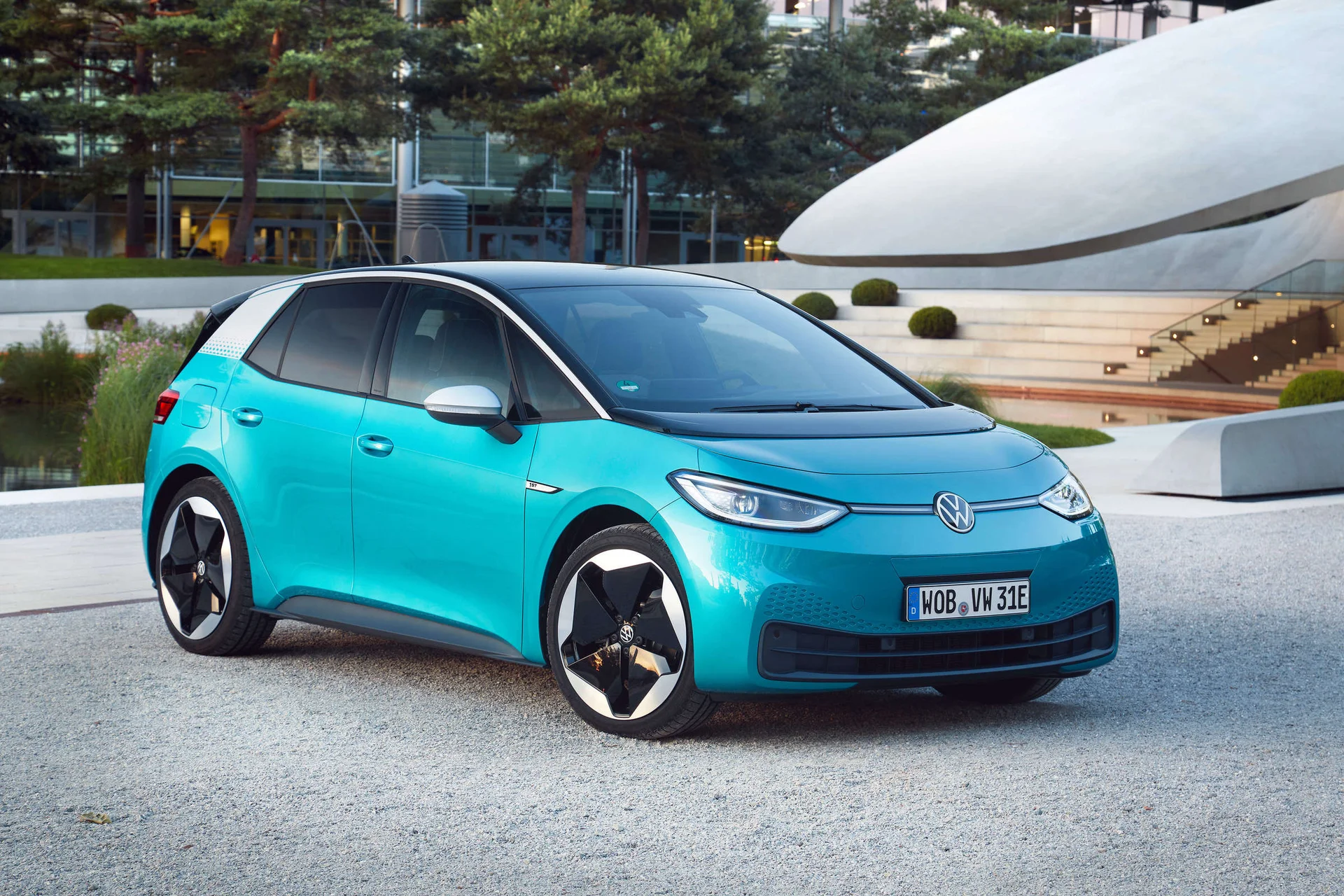
The ID.3 went on sale in 2020 as the Pro Performance, with a 58 kWh battery and a 150 kW (204 PS) motor, and the Pro S, with a 77 kWh battery and the same motor. The first cars were the ID.3 1ST launch editions, with a 58 kWh battery and "1ST" badges on the front wings. A cheaper 58 kWh Pro with 107 kW (146 PS) followed, and in 2021 Volkswagen added the Pure Performance, with a 45 kWh battery and 110 kW (150 PS).
All three are rear-wheel drive, with the motor at the back, a 10.2-metre turning circle and a top speed of 160 km/h. Volkswagen quotes 0-100 km/h in 7.3 seconds for the 58 kWh Pro Performance and 7.9 seconds for the heavier Pro S.
Volkswagen revealed a facelifted ID.3 in March 2023, and customers who ordered then got their cars from the end of 2023. It's easy to tell apart. On the first-generation car there's a black strip across the base of the windscreen, running down onto the bonnet, and the rear lights stop at the edge of the tailgate. The facelift drops the black strip, has a new front bumper and tail lights that continue onto the tailgate. Inside, the early car has a 10-inch central touchscreen and harder plastics; the facelift has a standard 12-inch screen, softer surfaces and newer software. If you're looking at a 2023 car, check which one it is.
Battery, range and charging
The 58 kWh battery suits most drivers. Its WLTP range of up to 426 km covers a week of commuting for most people, and it charges at up to 100 kW. The 77 kWh Pro S adds more than 120 km of range and charges at up to 125 kW; Volkswagen says it goes from 5% to 80% in around half an hour. The 45 kWh car is the one to be careful with: its 352 km rating is fine for town, but check whether it has the optional 100 kW charging, because the standard 50 kW makes rapid charging slow.
At home, the ID.3 charges at up to 11 kW AC, depending on the battery. On a typical 7 kW home charger, that won't matter.
Battery health is the key check. Ask for a battery health report from a Volkswagen dealer or an independent EV specialist, and look out for listings that state a state of health (SOH) figure. In the Netherlands, where sellers often list it, three- and four-year-old ID.3s typically show 89-95%.
Winter range is where the heat pump matters. It was an option on the first-generation ID.3, so many used cars don't have one, and those that do usually say so in the listing. A heat pump warms the cabin using far less energy than a resistive heater, which makes a real difference to range in cold weather.
Older cars also missed out on manual battery preconditioning, which warms the battery before a rapid charge. Volkswagen is now rolling it out by software update to ID. models on generation 3 software; see our article on battery preconditioning for older VW ID. models.
Warranty
Volkswagen guarantees that the battery will keep at least 70% of its original capacity for eight years or 160,000 km, whichever comes first. For a car first registered in 2020, that runs until 2028, so even the oldest ID.3s still have a few years of battery cover, provided they haven't covered 160,000 km. Ask a Volkswagen dealer to confirm what cover is left on a specific car, using its registration or VIN.
Common problems and recalls
Software was the ID.3's weak spot when new. Early cars were criticised for slow, glitchy infotainment and missing features, which Volkswagen fixed through a series of updates. Make sure any car you're looking at has been updated to the latest version Volkswagen offers for it: ask the seller, or check the software version in the car's settings.
There have been three battery actions worth knowing about:
- 2022: early battery modules. Around 10,000 ID.3s and ID.4s built in 2020 were found to have battery modules that could discharge themselves faster than they should. Dealers identified the affected cars from diagnostic data and replaced the modules free of charge.
- March 2026: early Pro S cars. Volkswagen recalled early-build ID.3 Pro S cars because cell modules in the high-voltage battery could overheat while charging. The fix is a software update and, where needed, new modules.
- October 2026: 80% charge limit. Volkswagen is recalling ID.3s built between 2022 and 2025 with cells from one supplier, limiting charging to 80% until the battery is checked. We covered it in our article on the VW ID battery recall.
Like many EVs, the ID.3 relies on its 12-volt battery to wake up, and a weak 12-volt battery is a common cause of breakdowns in electric cars, according to Germany's ADAC. If a car has warning lights that come and go, ask when the 12-volt battery was last replaced.
To check a car for open recalls, use the GOV.UK recall checker in the UK, or give the registration or VIN to a Volkswagen dealer elsewhere.
What to check before you buy
- A battery health (SOH) report, ideally from a Volkswagen dealer.
- The software version, and that all updates and recall work have been done.
- Whether the car has a heat pump, if you do a lot of winter driving.
- On a 45 kWh car, whether it has 100 kW rapid charging.
- That rapid charging works: if you can, try a short charge at a public charger.
- The charging cables are present, including the Type 2 cable for public charging.
- The 12-volt battery's age, and no intermittent warning lights.
Running costs and tax
In the UK, electric cars registered between April 2017 and March 2025 pay the standard rate of vehicle tax, £200 a year, and the expensive car supplement only applies to electric cars registered from April 2025. That means every first-generation ID.3 pays the standard rate.
In Ireland, a car that's already registered here has paid its VRT. An import pays VRT when it's first registered, based on Revenue's valuation of the car, and electric cars get relief of up to €5,000, used imports included (see our article on VRT relief for electric cars). A private import from Great Britain may also pay customs duty and 23% VAT, so check Revenue's rules and get the full cost before you buy.
Prices
The 58 kWh car makes up most of the market, and its price depends more on mileage and year than on whether it's a Pro or Pro Performance. The rarer Pro S can be a bargain: the few we found were priced in line with 58 kWh cars of the same age.
| Version | Ireland | Germany | Netherlands | France | UK |
|---|
| 45 kWh (2021-2023) | Few for sale | €17,000-€22,000 | €18,000-€22,000 | Few for sale | Few for sale |
| 58 kWh (2020-2021) | €16,000-€19,000 | €19,000-€20,000 | €17,000-€20,000 | €18,000-€21,000 | £12,000-£14,500 |
| 58 kWh (2022-2023) | €16,000-€25,000 | €21,000-€24,000 | €21,000-€26,000 | €21,000-€23,000 | £13,500-£19,000 |
(Rough asking-price ranges from dealer and private listings, November 2026. Mileage, condition and how you pay, whether a trade-in, finance or cash, can all move the final price. Irish prices are for cars already registered in Ireland; UK prices leave out the cost of importing, covered under Running costs and tax.)
Alternatives
A used Nissan Leaf (2018-2025) is cheaper, but it lacks the ID.3's battery cooling, and charges on the slower CHAdeMO standard. Check it carefully for battery wear.
A used Renault Zoe Z.E. 50 is a smaller supermini with a similar WLTP range to the 58 kWh ID.3, but it charges far more slowly at a rapid charger and has a zero-star Euro NCAP rating.
A used Tesla Model 3 (2019-2023) costs more, but goes further and charges faster, with access to Tesla's Supercharger network. It's a saloon rather than a hatchback.
Which one to buy
Go for a 58 kWh Pro or Pro Performance from 2022 or later, with a heat pump, up-to-date software and a clean battery health report. By then, Volkswagen had fixed the worst of the early software problems, and the battery warranty still has several years to run. Check whether the car is in the October 2026 recall, and if it is, make sure the work has been done or booked.
If you do a lot of motorway miles, a Pro S is worth seeking out, especially as it costs little more. Avoid a 45 kWh car with 50 kW charging unless it will only ever be used around town.
FAQs
Is a used VW ID.3 a good buy?
Yes, if you choose carefully. A 58 kWh car from 2022 onwards with updated software and a heat pump is good value, with up to 426 km of WLTP range and battery cover until at least 2030.
What are the common VW ID.3 problems?
Software glitches on early cars, 12-volt battery trouble, and battery recalls, including the October 2026 recall that limits charging to 80% on some cars built from 2022. Check the software is up to date and the recall work is done.
How long is the VW ID.3 battery warranty?
Eight years or 160,000 km, whichever comes first, with Volkswagen guaranteeing at least 70% of the original capacity.