Which years and versions
The second-generation Leaf went on sale in Europe in early 2018 with a 40 kWh battery, launched as the 2.ZERO edition. It was the first EV to be tested under WLTP, and its 270 km (168 miles) combined range was a big step up from the 24 kWh and 30 kWh first-generation cars, which look completely different, with rounded headlights and a bulbous nose.
The e+ was revealed in January 2019 and reached customers from summer 2019, starting with the 3.ZERO e+ Limited Edition, of which 5,000 were built for Europe. Its 62 kWh battery has 288 cells to the 40 kWh pack's 192, adding about 40% more range, and its 160 kW motor makes it noticeably quicker. From the outside it's hard to tell apart: look for the e+ badge, or check the battery size on the registration document or in the advert. The 2019 3.ZERO editions also brought an 8-inch touchscreen with door-to-door navigation.
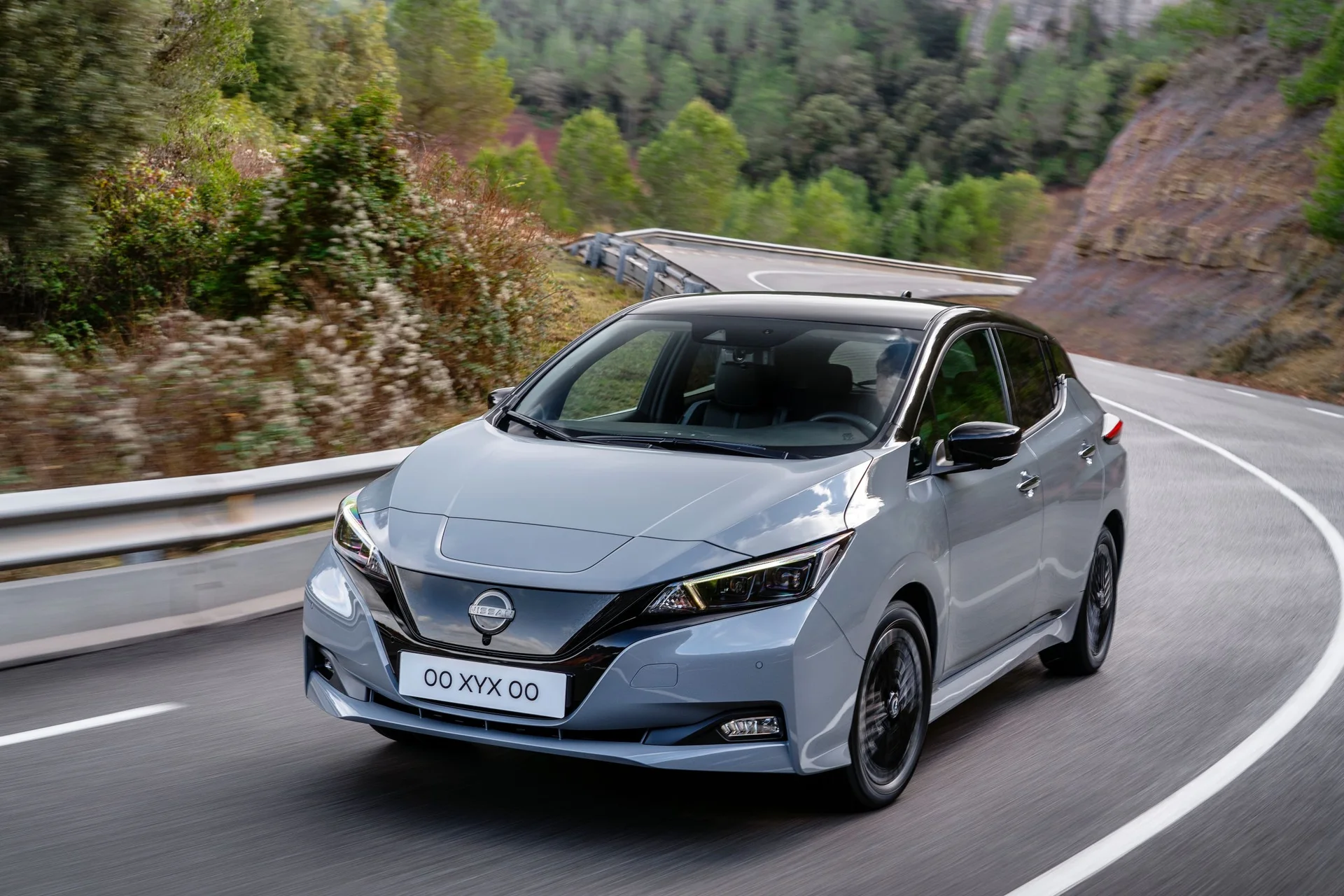
In April 2022, an update gave the Leaf Nissan's new logo on the grille, the wheels and the tailgate, new 16-inch and 17-inch wheels with black inserts and two new blue paints. Underneath, little changed. The e+ was dropped from some markets in 2023, including the UK, while the 40 kWh car carried on until the new Leaf arrived.
European trims ran from Visia through Acenta and N-Connecta to Tekna, with special editions such as the Shiro. Apple CarPlay, Android Auto and the e-Pedal, which lets you drive in town with one pedal and stop the car fully when you lift off, were standard on all versions from 2019. Many cars also have ProPILOT, which keeps the car in its lane and at a set distance from the car in front, so check whether the one you're looking at does. A heat pump was standard on some versions and optional on others, depending on trim, year and market, so check for it if you live somewhere cold. Many Irish adverts use non-European trim names, so judge each car by its equipment.
Battery, range and charging
This is the most important part of buying a used Leaf. Unlike most EVs, the Leaf has no liquid cooling for its battery: it relies on air. That works fine in everyday driving, but it has two consequences.
The first is that the battery tends to lose capacity faster than liquid-cooled rivals, especially on cars that have lived in hot climates or been rapid-charged often. Two Leafs of the same age can have very different batteries. The good news is that the Leaf shows you: next to the charge meter, a gauge of 12 small bars shows the battery's remaining capacity. A full 12 bars is what you want to see, and every missing bar means noticeably less range. For a precise reading, ask for a state-of-health report from a Nissan dealer or use an app with a Bluetooth OBD reader, which shows the exact percentage.
The second is rapid charging on long trips. Owners and testers widely report that a second or third rapid charge on the same journey heats the battery up, and the car then slows down the charge to protect it. For a car that charges at home and does the occasional long trip, this rarely matters. If you regularly drive several hundred kilometres in a day, it will.
Rapid charging also uses CHAdeMO, a Japanese standard that most of Europe has moved away from. Plenty of older charging sites still have a CHAdeMO cable, but many new hubs, including Ionity, offer only CCS, so check the chargers on your regular routes before you buy. On a 50 kW charger, expect around 40-60 minutes for 10-80%, depending on the battery size and temperature. At home, most cars charge at 6.6 kW, which takes about 7 hours from empty for the 40 kWh battery and about 11 hours for the e+. Some early Visia models have a 3.6 kW charger, which nearly doubles those times.
Warranty
Nissan covered the battery for eight years or 160,000 km (100,000 miles in the UK), whichever came first. That means the very first 2018 cars are losing their battery cover now, in 2026, while a 2022 car is covered until 2030. Nissan has also guaranteed the battery against losing too much capacity, measured on the 12-bar gauge, so check the exact threshold in the car's warranty booklet, and ask a dealer to confirm the warranty start date for the car you're looking at.
The rest of the car had a three-year or 100,000 km (60,000 miles) warranty, so that has run out on all but the newest cars.
Common problems and recalls
The Leaf's motor and electronics have a good record, and with no oil, clutch or exhaust, there's less to go wrong than on a petrol car. Beyond the battery, the things to watch are the usual EV ones: brake discs that rust because regenerative braking does most of the stopping, and an ageing 12-volt battery, which can stop the car starting if it's weak.
In 2023, Nissan recalled the second-generation Leaf in the UK to update the software in its vehicle control module, a free job that takes about an hour. A Nissan dealer can check whether a car's recall work has been done, and in the UK you can check the registration on the GOV.UK recall checker.
What to check before you buy
- The capacity gauge. Count the bars next to the charge meter: 12 is ideal, and fewer should be reflected in the price.
- Battery health report. Ask for a state-of-health percentage from a dealer or an OBD reading.
- Range at full charge. Charge it to 100% and check the range shown, bearing in mind it varies with the weather and driving.
- Battery size. Confirm 40 kWh or 62 kWh from the paperwork, not just the advert.
- On-board charger. Check whether it's the 3.6 kW or 6.6 kW unit if you'll charge at home.
- Heat pump. Check whether the car has one, as it makes a big difference to winter range.
- CHAdeMO access. Check your regular routes for CHAdeMO chargers.
- Warranty dates. Find out when the car was first registered, to know how much battery cover is left.
- Recalls. Make sure all recall work is done.
- Brakes and 12-volt battery. Look for rusty discs, and ask when the 12-volt battery was last replaced.
- Charging cables. Check which cables come with the car.
Running costs and tax
The Leaf is cheap to run. At a home electricity rate of 30 cent per kWh, a full charge of the 40 kWh battery costs about €12, or about €18 for the e+, and less on an off-peak EV tariff. There's no oil to change, and servicing is mostly checks and the cabin filter.
In the UK, electric cars registered from April 2017 pay the standard rate of vehicle tax, £200 a year. In Ireland, a car that's already registered here has paid its VRT, but an import pays it when it's first registered, based on Revenue's valuation of the car. Electric cars get relief of up to €5,000, used imports included, reduced for cars Revenue values above €40,000 and none above €50,000. The relief applies to cars registered before the end of 2026, and Budget 2027 extends it to the end of 2028, subject to EU approval (see our article on VRT relief for electric cars). The SEAI grant is for new cars only. A private import from Great Britain also pays VAT at 23% on arrival, and customs duty too unless the car qualifies as UK-made under the EU-UK trade agreement, so check with Revenue first: most European Leafs were built in Sunderland.
Prices
The battery sets the price of a used Leaf more than anything else. An e+ costs several thousand more than a 40 kWh car of the same age, and a car with lost capacity bars should be cheaper than one with all 12. In Germany the e+ is plentiful, while in France so few are for sale that the 40 kWh car is the realistic choice.
| Version | Ireland | Germany | Netherlands | France | UK |
|---|
| 40 kWh (2018-2025) | €8,500-€19,500 | €12,000-€25,000 | €9,000-€21,000 | €10,000-€21,000 | £5,500-£14,500 |
| e+ (2019-2024) | €11,000-€20,000 | €16,000-€29,000 | €18,000-€22,000 | Few for sale | £12,000-£17,000 |
(Rough asking-price ranges from dealer and private listings, November 2026. Mileage, condition and how you pay, whether a trade-in, finance or cash, can all move the final price. Irish prices are for cars already registered in Ireland; UK prices leave out the cost of importing, covered under Running costs and tax.)
Alternatives
The Renault Zoe Z.E. 50 is the obvious rival at this money. It has a 52 kWh battery and 22 kW AC charging, but it scored zero stars from Euro NCAP, and rapid charging was an option. The Leaf scored five stars in 2018.
The Hyundai Kona Electric, from the same years, has a liquid-cooled 64 kWh battery and CCS rapid charging, and more range than an e+, though used prices are usually higher.
The VW ID.3, on sale from 2020, is a newer design with CCS charging as standard and a choice of batteries, if you can stretch your budget.
Which one to buy
For most buyers, the best used Leaf is a 2022 or later e+ with 12 capacity bars, a heat pump and plenty of battery warranty left. It goes furthest, it's the quickest, and its bigger battery is less stressed by rapid charging.
If you mainly drive in town and charge at home, a low-mileage 40 kWh car from 2020 onwards with the 6.6 kW charger is a sensible, cheaper choice. Whichever you choose, the battery report matters more than the year or the trim. For something newer, the new Nissan Leaf is a completely different car, a crossover with CCS charging (see the Nissan Leaf specs).
FAQs
Is a used Nissan Leaf a good buy?
It can be, as long as the battery is healthy. The second-generation Leaf scored five stars from Euro NCAP, it's cheap to run and simple, and used prices are low. Check the capacity gauge and get a battery health report, and make sure CHAdeMO charging works for your trips.
How long do Nissan Leaf batteries last?
They vary more than most, because the battery is air-cooled. Heat and frequent rapid charging speed up capacity loss. The 12-bar gauge next to the charge meter shows how much is left, and the battery was covered for eight years or 160,000 km from new.
Can a Nissan Leaf use CCS chargers?
No. The second-generation Leaf uses CHAdeMO for rapid charging, plus a Type 2 socket for AC charging. Plenty of older charging sites still have CHAdeMO, but many new hubs offer only CCS.