Which years and versions
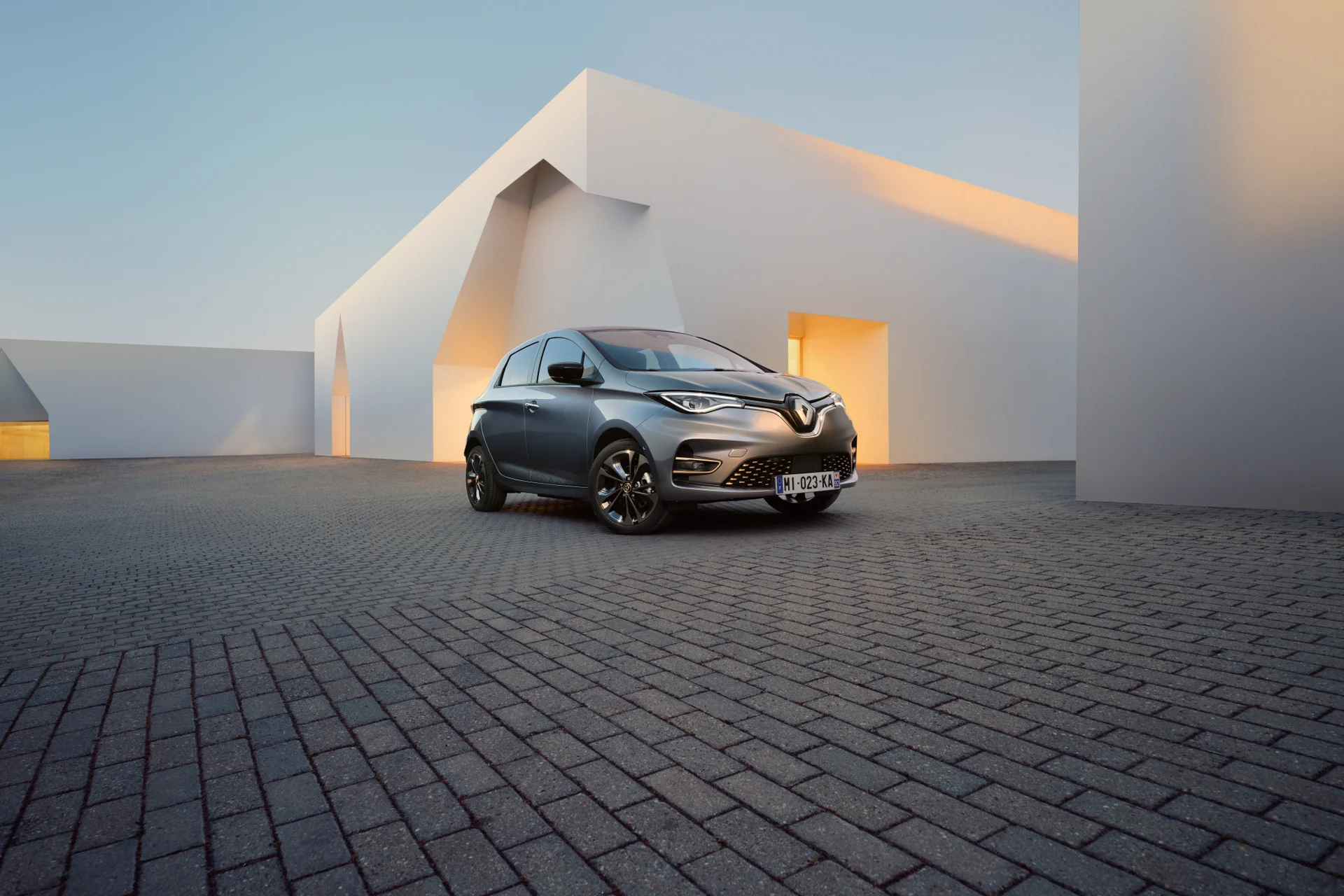
Renault revealed the Z.E. 50 in June 2019, and the first cars reached customers around the turn of 2020. It looks like the earlier Zoe from the outside, but it has a new nose with full LED headlights, a much better cabin with a 10-inch driver's display, and the larger battery that gives it its name. If you're looking at older, cheaper Zoes with 22 kWh or 41 kWh batteries, those are a different proposition, with less range and a higher chance of battery lease.
There are two motors. The R110 produces 80 kW and is the more efficient choice. The R135 produces 100 kW and 245 Nm, and reaches 100 km/h in 9.5 seconds, which makes it noticeably livelier on faster roads.
Trim names varied by country and changed over the years, so judge a car by its equipment rather than its badge. The 2022 model year is the clearest example. Renault renamed the trims Equilibre, Evolution and Iconic, and made automatic emergency braking standard from the entry-level car upwards. Even the Equilibre has the 22 kW charger, keyless entry, the 10-inch driver's display and a 7-inch touchscreen with Apple CarPlay and Android Auto.
The Evolution adds traffic sign recognition, lane departure warning and lane keeping assist, rear parking sensors, automatic air conditioning and built-in navigation, which makes it the sweet spot for most buyers. The Iconic has 17-inch alloy wheels, a larger 9.3-inch touchscreen and seats trimmed partly in recycled fabric. Renault also said all Zoes ordered from 1 March 2022 would have automatic emergency braking as standard, so a car's order date matters as much as its trim.
Earlier Z.E. 50s have broadly similar equipment, but driver assistance was patchier, so check what a particular car has rather than assuming. Every Z.E. 50 has a B mode on the gear selector, which increases regenerative braking for something close to one-pedal driving in town.
Charging: check for the CCS socket
Every Z.E. 50 has a 22 kW AC charger, which is still unusual among small EVs. On a 22 kW public charger, that means a much faster top-up than most rivals manage, and Renault said it recovers energy up to three times faster than its closest competitors.
Rapid charging is a different story. The 50 kW CCS socket was an option on many versions, so plenty of used Zoes can't use a rapid charger at all. To check, open the charging flap behind the Renault badge on the nose: a car with rapid charging has the larger CCS socket, with two extra pins below the standard Type 2 connector. Renault quoted about 150 km of range in 30 minutes on a 50 kW charger. If you only charge at home and drive locally, a car without CCS is fine, but it will be harder to sell later.
Battery lease: check before you buy
The Zoe was famous for battery lease: buyers could pay for the car and rent the battery monthly. Where you are makes a big difference here. In the UK and Ireland, Renault stopped offering battery lease in late 2019, around the time the Z.E. 50 arrived, so most cars there have their battery included. In France, Germany and the Netherlands, though, plenty of 2020 and 2021 Z.E. 50s were sold with a rented battery, and many are still advertised that way: look for "batterie louée", "Batteriemiete" or "huuraccu" in the advert, against "batterie achetée", "Kaufbatterie" or "koopaccu" for an owned one.
A rented battery explains a lot of the cheaper adverts. The contract has to be taken over or bought out, so it adds a monthly cost or a lump sum to the price. Whichever country you buy in, ask the seller for written confirmation from Mobilize Financial Services, which manages Renault's battery contracts, of whether there's a contract and what it would cost to buy out.
The battery itself is covered for eight years or 160,000 km (100,000 miles in the UK), with at least 70% of its capacity guaranteed, so the earliest cars are covered until about 2028. Ask for a state-of-health reading, which a Renault dealer or an EV specialist can provide.
Safety: the zero-star Euro NCAP rating
In December 2021, Euro NCAP retested the Zoe and gave it zero stars. It scored 43% for adult occupant protection, 52% for child occupants, 41% for vulnerable road users and 14% for safety assist systems. The car tested was an 80 kW (R110) version, and the adult score was the lowest Euro NCAP had recorded in 11 years.
Two things caused it. The 2019 update replaced the seat-mounted side airbag, which had protected the head and chest, with one that protects only the chest, so in the side pole test the driver's head was poorly protected. The frontal tests also showed a risk of serious chest injuries. And the car Euro NCAP tested didn't have automatic emergency braking, which is why the safety assist score was so low.
Renault's response was to make automatic emergency braking standard on cars ordered from March 2022, but that doesn't change the airbag or the crash structure, so the rating applies to every Z.E. 50. A Zoe with automatic emergency braking can help you avoid a crash, but it protects you no better in one. For that you need a newer car: the Renault 5 that replaced it scored four stars.
Common problems and recalls
The Zoe's electric motor and battery have a good record, and the car's simple design means there's less to go wrong than on most EVs. Recalls are where you need to be careful. Cars built between September and December 2019 were recalled for a possible short circuit in the drive battery, and there have since been recalls for the power steering (2020), a further battery issue (2022), a rear seat backrest that could fail (2023), and another possible battery short circuit affecting cars built in September 2023 (2024).
A Renault dealer can check, free of charge, whether a car's recall work has been done. In the UK you can also check the registration on the GOV.UK recall checker.
What to check before you buy
- Battery lease. Get written confirmation that the battery is owned outright.
- Rapid charging. Look for the CCS socket if you need it.
- The nose. Check for damage around the charging flap: a knock to the front can stop the car from plugging in.
- Safety kit. Check whether the car has automatic emergency braking.
- Recalls. Make sure every recall has been done, especially the battery recalls.
- Battery health. Ask for a state-of-health reading and check the range shown at full charge.
- Charging cables. Check which cables come with the car. A Type 2 cable for public charging is the one you'll use most.
- Brakes. Look for rust on the discs, which is common on EVs that rarely brake hard.
- Wheels and tyres. Bigger wheels cut the range, so factor that in on cars with 17-inch alloys, and check the tyres for uneven wear.
- Service history. Renault set regular service intervals, so ask for the record.
Running costs and tax
The Zoe is cheap to run. At a home electricity rate of 30 cent per kWh, filling the 52 kWh battery from empty costs about €16, and much less on an off-peak EV tariff. The brakes last a long time because regenerative braking does most of the slowing down, but that also means the discs can rust, so check them.
In the UK, electric cars registered from April 2017 pay the standard rate of vehicle tax, £200 a year. In Ireland, a car that's already registered here has paid its VRT, but an import pays it when it's first registered here, based on Revenue's valuation of the car. Electric cars get relief of up to €5,000 at that point, used imports included, reduced for cars Revenue values above €40,000 and none above €50,000. The relief applies to cars registered before the end of 2026, and Budget 2027 extends it to the end of 2028, subject to EU approval (see our article on VRT relief for electric cars). The SEAI grant, on the other hand, is for new cars only. Because the Zoe was built in France, not the UK, a private import from Great Britain also pays customs duty and 23% VAT on arrival.
Prices
The battery is the first thing to check against the price. In Germany, cars advertised with a rented battery were asking €1,000-€3,000 less than similar cars with the battery included, and the ranges below are for cars that come with their battery. After that, age and rapid charging set the price: a 2022 or later R135 with the CCS socket sits at the top of each range.
| Version (2020-2024) | Ireland | Germany | Netherlands | France | UK |
|---|
| R110 | €10,000-€18,000 | €14,000-€18,000 | €13,000-€17,000 | €11,000-€19,000 | £7,500-£10,000 |
| R135 | €11,000-€21,000 | €13,000-€19,000 | €15,000-€23,000 | €14,000-€19,000 | £8,500-£14,000 |
(Rough asking-price ranges for cars with the battery included, from dealer and private listings, November 2026. Mileage, condition and how you pay, whether a trade-in, finance or cash, can all move the final price. Irish prices are for cars already registered in Ireland; UK prices leave out the cost of importing, covered under Running costs and tax.)
Alternatives
The obvious alternative is the Zoe's successor, the Renault 5, which scored four stars from Euro NCAP and has rapid charging as standard, though it's newer, so used ones are scarcer. See the Renault 5 E-Tech specs.
The Peugeot e-208 is a similar size and age and comes with 100 kW rapid charging as standard, though its smaller battery gives it less range than the Zoe.
The MG4, on sale from 2022, is a bigger car with rapid charging as standard and a choice of battery sizes, if you need more space.
Which one to buy
The best used Zoe is a 2022 or later R135 with the CCS rapid-charging socket and automatic emergency braking. It has the livelier motor, can be used for longer trips, and gives you the best safety kit the Zoe offered.
If you'll mostly drive around town and charge at home, an R110 without rapid charging is a sensible, cheaper buy, and it goes slightly further on a charge. Whichever you choose, check the battery is owned and the recall work is done.
FAQs
Does a used Renault Zoe have battery lease?
In the UK and Ireland, most don't, because Renault stopped offering battery lease there in late 2019. In France, Germany and the Netherlands, many 2020 and 2021 cars have a rented battery. Either way, ask the seller for written confirmation from Mobilize Financial Services before you buy.
Why did the Renault Zoe get zero stars from Euro NCAP?
When Euro NCAP retested it in 2021, a new side airbag gave less head protection in the side pole test, the frontal tests showed a risk of chest injuries, and the car tested had no automatic emergency braking.
Can a Renault Zoe rapid charge?
Only if it has the optional 50 kW CCS socket. Every Z.E. 50 can charge at up to 22 kW from a public AC charger.