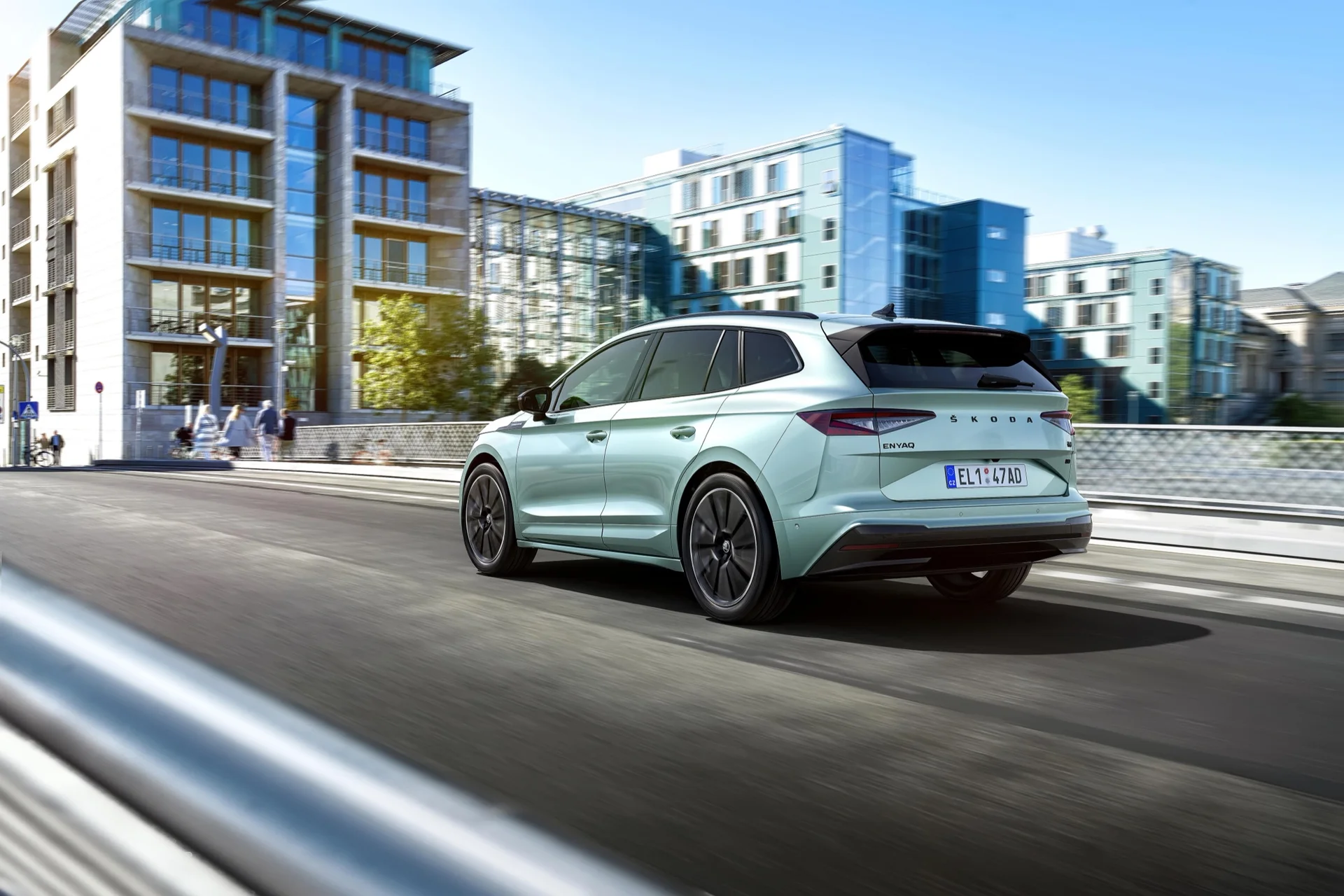
Which years and versions
The Enyaq iV was revealed in Prague in September 2020, and the first full year on the road was 2021. At launch there were three main versions: the iV 60, with a 58 kWh usable battery and a 132 kW rear motor; the iV 80, with 77 kWh and 150 kW; and the four-wheel-drive iV 80x, which adds a front motor for 195 kW. Some markets also had the entry iV 50, with a 52 kWh battery and slower charging, which is common in Germany but rare elsewhere. Early cars were also sold as a Founders Edition, with a numbered plaque and a long list of equipment.
The Enyaq Coupé iV, with a sloping roof and a 570-litre boot, was revealed in January 2022 alongside the first vRS, the sporty version, with 220 kW and four-wheel drive, and a vRS version of the regular Enyaq followed. Mechanically, the Coupé is the same car, and its smoother shape gives the iV 80 a little more range, up to 545 km.
The biggest software change came in August 2022 with update ME3. It raised peak charging to 120 kW for the 58 kWh battery and 135 kW for the 77 kWh battery, added a battery care mode that stops at 80%, improved the sat nav's charging planning and made later updates possible over the air. Cars already on the road got it free, in a roughly five-hour dealer visit, and new cars came with it. Every pre-2023 car you look at should have had it.
From November 2023, the 2024 model year brought a new rear motor. The 80 and 80x became the 85 and 85x, both with 210 kW and 545 Nm, and the vRS went up to 250 kW. The 85 is almost two seconds quicker to 100km/h than the 80 and goes up to 565 km on a charge. The four-wheel-drive 85x and vRS also charge at up to 175 kW, cutting the 10-80% time to 28 minutes, eight minutes less than before. These cars dropped the iV badge, came with newer infotainment software and, for the first time, could warm the battery automatically when you set a fast charger as your destination.
The facelifted Enyaq, revealed in January 2025, is easy to spot: its front has a black panel with a light strip in place of the traditional grille, and it isn't covered here. If you're unsure which car you're looking at, the first registration date and the version name on the logbook or the advert ("iV 80", "85x") tell you most of what you need. Many dealer adverts also list the charging speed ("DC135kW").
Battery, range and charging
Every Enyaq of this generation uses the same lithium-ion battery sizes: 52 kWh, 58 kWh or 77 kWh usable. The range figures in the table are what Skoda quoted when the cars were new. In everyday driving, expect noticeably less on the motorway and in winter, especially without a heat pump, which was an option rather than standard. A heat pump is worth having in a cold climate, so check the specification.
Published degradation data for the Enyaq is thin, but its batteries appear to age well. Dealer adverts that quote a battery state of health typically show around 90-93% on cars that have covered 50,000-150,000 km. Ask for a state-of-health report from a Skoda dealer or a battery test service, and check the range the car shows at a full charge, allowing for the weather.
Charging is where versions differ most. The iV 60 now charges at up to 120 kW and takes about 35 minutes from 10% to 80%, and the iV 80 at up to 135 kW, taking about 29 minutes. The iV 80x and vRS iV also peak at 135 kW but take a little longer, about 36 minutes. On the 2024 85x and vRS, 175 kW brings that down to 28 minutes, while the 85 stays at 135 kW. At home, every version except the iV 50 charges at up to 11 kW where you have a three-phase supply, which fills the 77 kWh battery from empty in about seven and a half hours.
Older cars also lacked battery preconditioning, which slows rapid charging in cold weather. That's now changing: Skoda is rolling out software 3.9 to every Enyaq built up to the end of 2023, adding a button to warm the battery before a fast charge (see our story on battery preconditioning for older Enyaqs). It's manual, unlike the 2024 cars' automatic version, and needs the car to be on recent software first.
Warranty
Skoda covers the high-voltage battery for eight years or 160,000 km (100,000 miles in the UK), whichever comes first, against defects and against its capacity falling below 70%. In Ireland, Skoda sets a higher bar for younger cars: a battery found below 70% is repaired to at least 78% of its original capacity in the first three years or 60,000 km, and 74% up to five years or 100,000 km. That means even the first 2021 cars have battery cover until 2029, unless they've passed the mileage limit.
The rest of the car had a three-year warranty from new, which in Ireland means unlimited mileage for two years and up to 150,000 km in the third. That has run out on all but the newest cars. The warranty conditions require servicing to Skoda's schedule, so ask for the service history, and have a Skoda dealer confirm the warranty start date for the car's VIN.
Common problems and recalls
The Enyaq's reliability record is solid rather than outstanding. In one large UK owner survey it scored 88.6%, in the middle of the pack among electric SUVs, with owners mainly reporting warning lights with no clear cause, charging faults and infotainment glitches. Most of these are software-related, so a car that's kept up to date with Skoda's updates is the safer buy.
The big VW Group battery recall of 2026, which limited some VW ID. models and the Cupra Born to an 80% charge, doesn't include Skoda models (see our story on the VW battery recall). Even so, check any car for open recalls and service campaigns: in the UK, use the registration on the GOV.UK recall checker; elsewhere, a Skoda dealer can check by VIN.
The Enyaq iV scored five stars in Euro NCAP's 2021 tests, with 94% for adult occupants, 89% for children, 71% for vulnerable road users and 82% for safety assistance, and Euro NCAP named it best in its class that year.
What to check before you buy
- Charging speed. Confirm the car's peak DC charging speed. Some early UK cars came with 50 kW as standard, and the faster option may not have been added.
- Software version. Check it's had the ME3 update, and which version it's on: cars still on 2.x need a dealer visit before they can get the battery preheating update. You'll find it in the MyŠkoda app under Inspect and Car details.
- Battery health. Ask for a state-of-health report, and check the range shown at 100%.
- Heat pump. It was optional, so check whether the car has one.
- Version and battery. Confirm 58 or 77 kWh and the version name from the paperwork, not just the badge.
- Service history. Gaps can affect the battery warranty.
- Warranty dates. Find the first registration date to work out how much battery cover is left.
- Recalls and campaigns. Make sure any outstanding work is done.
- Charging cables. Check which cables come with the car.
- Wheels and tyres. Big alloys kerb easily, and EVs wear tyres faster than you might expect.
Running costs and tax
At a home electricity rate of 30 cent per kWh, a full charge costs about €17 for the 58 kWh battery and €23 for the 77 kWh battery, and less on an off-peak EV tariff. Servicing is simpler and cheaper than a petrol Skoda's, with no oil changes.
In the UK, an electric car registered before April 2025 pays the standard vehicle tax rate of £200 a year, and electric cars registered before 1 April 2025 are exempt from the expensive car supplement even if their list price was high. In Ireland, motor tax on an electric car is €120 a year. A car already registered in Ireland has paid its VRT, while an import pays it on first registration, based on Revenue's valuation; electric cars get relief of up to €5,000, reduced for cars valued above €40,000 and none above €50,000, for cars registered before the end of 2026, and Budget 2027 extends this to the end of 2028, subject to EU approval (see our article on VRT relief for electric cars). A private import from Great Britain also pays VAT at 23%, and customs duty may apply, so check with Revenue first. The SEAI grant is for new cars only.
Prices
The battery and the motor set the price more than anything. A 77 kWh iV 80 often costs only a little more than a 58 kWh iV 60 of the same age, which makes it the better buy for most people, while the vRS and the 2024 85x hold their value best. The very cheapest cars in Germany and the Netherlands tend to have covered well over 150,000 km.
| Version | Ireland | Germany | Netherlands | France | UK |
|---|
| iV 50 and 60 | €19,000-€31,000 | €19,000-€32,000 | €16,000-€29,000 | Few for sale | £11,000-£20,000 |
| iV 80 and 80x | €22,000-€39,000 | €22,000-€35,000 | €19,000-€40,000 | Few for sale | £12,000-£27,000 |
| vRS (2022-2025) | Few for sale | €29,000-€50,000 | €33,000-€43,000 | €30,000-€42,000 | £24,000-£33,000 |
| 85 and 85x | Few for sale | €32,000-€46,000 | Few for sale | Few for sale | £22,000-£32,000 |
(Rough asking-price ranges from dealer and private listings, November 2026. Mileage, condition and how you pay, whether a trade-in, finance or cash, can all move the final price. Irish prices are for cars already registered in Ireland; UK prices leave out the cost of importing, covered under Running costs and tax.)
Alternatives
The Volkswagen ID.4 is the Enyaq's twin under the skin, with the same batteries and motors, and was hit by the 2026 battery recall on some cars. The Enyaq usually has the bigger boot and more equipment for the money.
A used Tesla Model Y costs more, but it charges faster on Tesla's Supercharger network and has more luggage space with its frunk. The Hyundai Ioniq 5 and Kia EV6, from the same years, charge much faster thanks to their 800-volt systems, though used prices are usually higher.
Which one to buy
For most buyers, the best used Enyaq is a 2022 or 2023 iV 80 with the ME3 update and a heat pump. It has the bigger battery, 135 kW charging and a 532 km WLTP range, and it costs little more than an iV 60. If you need four-wheel drive for towing or bad weather, the iV 80x is the one.
If your budget stretches, a 2024 Enyaq 85 is a real step up: 210 kW, the longest range of this generation, and automatic battery preheating. Avoid early cars with 50 kW charging unless you rarely drive long distances. For something newer, see the current Skoda Enyaq specs and prices, or the smaller Skoda Elroq.
FAQs
Is a used Skoda Enyaq a good buy?
Yes, for most families. It has a 585-litre boot, scored five stars from Euro NCAP, and the battery warranty runs for eight years or 160,000 km. Check the charging speed, the software version and the battery health before you buy.
How long does a Skoda Enyaq battery last?
Skoda expects its batteries to last 10 to 15 years depending on use, and guarantees at least 70% of the original capacity for eight years or 160,000 km. Cars in adverts with a stated battery health typically show around 90-93% after several years.
What's the difference between the Enyaq iV 80 and the Enyaq 85?
Both have a 77 kWh battery, but the 85, from the 2024 model year, has a new 210 kW rear motor in place of the 80's 150 kW, which makes it almost two seconds quicker to 100km/h and gives it up to 565 km of WLTP range against 532 km. It also warms its battery automatically before a fast charge.