Prices and trims
Choosing a Peaq starts with a straightforward choice of battery and drive, and then trim. Only some markets get the smaller battery, and the UK isn't one of them.
| Market | Peaq 60 | Peaq 90 | Peaq 90x | Sportline 90 | Sportline 90x |
|---|
| Germany | €49,900 | €57,900 | €60,400 | €62,800 | €65,300 |
| France | not listed | €56,460 | €59,310 | €59,760 | €62,610 |
| Ireland | €54,996 | €58,150 | €59,650 | €61,550 | €63,050 |
| UK | not sold | £51,980 | £57,230 | £58,280 | £60,380 |
(Prices correct at 9 November 2026. German prices are from Skoda's list dated 15 October 2026 and French prices from its list dated 14 October 2026. The German Sportline 60 is €54,800. UK 90 and 90x prices are for SE L and Edition respectively; the Edition 90 is £55,130. French cars have seven seats as standard, while the third row is a €990 option in Germany.)
Where you live changes the value more than you'd expect. France has the cheapest Peaq 90, at €56,460 with seven seats included, while a German buyer pays €57,900 and then €990 more for the third row. Ireland is the odd one out: the Irish 60 costs €5,096 more than the German car, but stepping up to the 90 costs only €3,154 there, against €8,000 in Germany, so the big battery looks much better value in Ireland.
In Ireland, Selection is the main trim and comes with heated front seats and a heated steering wheel, three-zone climate control, a heated windscreen, wireless charging for two phones and the 13.6-inch vertical touchscreen. Sportline adds 20-inch alloys, matrix LED headlights, gloss black exterior trim, sports seats and adaptive dampers. Skoda lists the heat pump as an option.
UK buyers get three trims. SE L has 19-inch alloys, LED headlights, an electric tailgate, heated front and rear seats and a heated windscreen. Edition adds a Suite interior, matrix headlights, an area view camera, remote parking and trained parking, and SportLine brings 20-inch wheels, black styling, sports seats and adaptive suspension.
Grants won't help here. The Irish SEAI grant of €3,500 only applies to cars with a full price of €50,000 or less, so even the cheapest Irish Peaq misses it, and VRT relief stops at an open market selling price of €50,000. The UK Electric Car Grant is limited to cars up to £37,000. Every UK Peaq is also over the £50,000 threshold for the expensive car supplement on road tax.
Battery, range and charging
The big battery is the one to have if you do long trips. It holds 86kWh usable from 91kWh gross, the most Skoda has fitted to any car, and the rear-wheel-drive 90's 642 km should mean you're not thinking about charging on most days. Your real range will depend on the wheels, the seats and how much you're carrying, and the list shows how far it can fall: a Peaq 90 runs from 553 km to 642 km depending on specification. The 90x loses about 33 km at the top of its range in exchange for all-wheel drive.
If you do use a rapid charger, the gain in the 90 is a peak of 199 kW and 10-80% in 28 minutes. That's about 60kWh in under half an hour, enough for around 400 km at the official consumption figure of 15.1 kWh per 100 km. The 60 is the smaller package, with 59kWh usable, a 160 kW peak and 27 minutes for 10-80%, which is a good fit if you mostly drive locally.
Both batteries use NMC cells and are built in Mladá Boleslav. The car can warm the battery before a charge using heat from the motors, battery and electronics, and AC charging runs at 11 kW, so a full charge takes 9 hours on the big battery and 6 hours 30 minutes on the small one.
You can also run things from the car. Vehicle-to-load works through a 230 V socket in the boot, rated up to 3.6 kW, or an adapter in the charging port. Skoda has also certified one home unit, the AmbiCHARGE Home 11 kW DC, for vehicle-to-home use.
Performance
None of the Peaqs is fast by EV standards, but all of them have enough performance for a seven-seater. The 60 makes 150 kW (204 hp) and 350 Nm, does 0-100km/h (0-62mph) in 8.4 seconds and tops out at 160 km/h (99 mph). The 90 makes 210 kW (286 hp) and 545 Nm for a 7.1-second sprint, and the 90x adds a front motor for 220 kW (299 hp) and 6.7 seconds. Both have a 180 km/h (112 mph) top speed.
There's a lot of weight to move. A five-seat 90 weighs between 2,309 kg and 2,432 kg, and a seven-seat 90x can reach 2,529 kg. Peak outputs need a high state of charge and a battery in its ideal temperature range, so expect less in deep cold or with a low battery. The rear wheels use drum brakes, and Skoda says the motor handles more than 95% of braking in B mode.
Driving and comfort
If you were hoping for anything sporty, this isn't where to look: Skoda has set the Peaq up for comfort. Standard cars have fixed dampers, with MacPherson struts up front and a five-link rear axle. Dynamic Chassis Control adds adaptive dampers with 14 levels of adjustment between Comfort and Sport. They're standard on UK SportLine cars and included with the Irish Sportline, and elsewhere they're an option.
Regen is simple to adjust. You can set it on the touchscreen, and paddles on the steering wheel come with Sportline models. Move the drive selector to B and the Peaq works as a one-pedal car, slowing to a complete stop using regen alone.
Road tests have broadly agreed on the Peaq's strengths. The ride is usually described as soft and relaxed, particularly with adaptive dampers, and the cabin as very quiet at motorway speeds, which suits a car like this. Steering is generally described as precise but without much feedback. Testers note that the body leans in corners and that it's a calm car to drive rather than an entertaining one.
Space in the third row gets a more mixed reaction. It's usually considered fine for children and smaller adults, and tight for six-footers unless the middle row slides forward.
Size and practicality
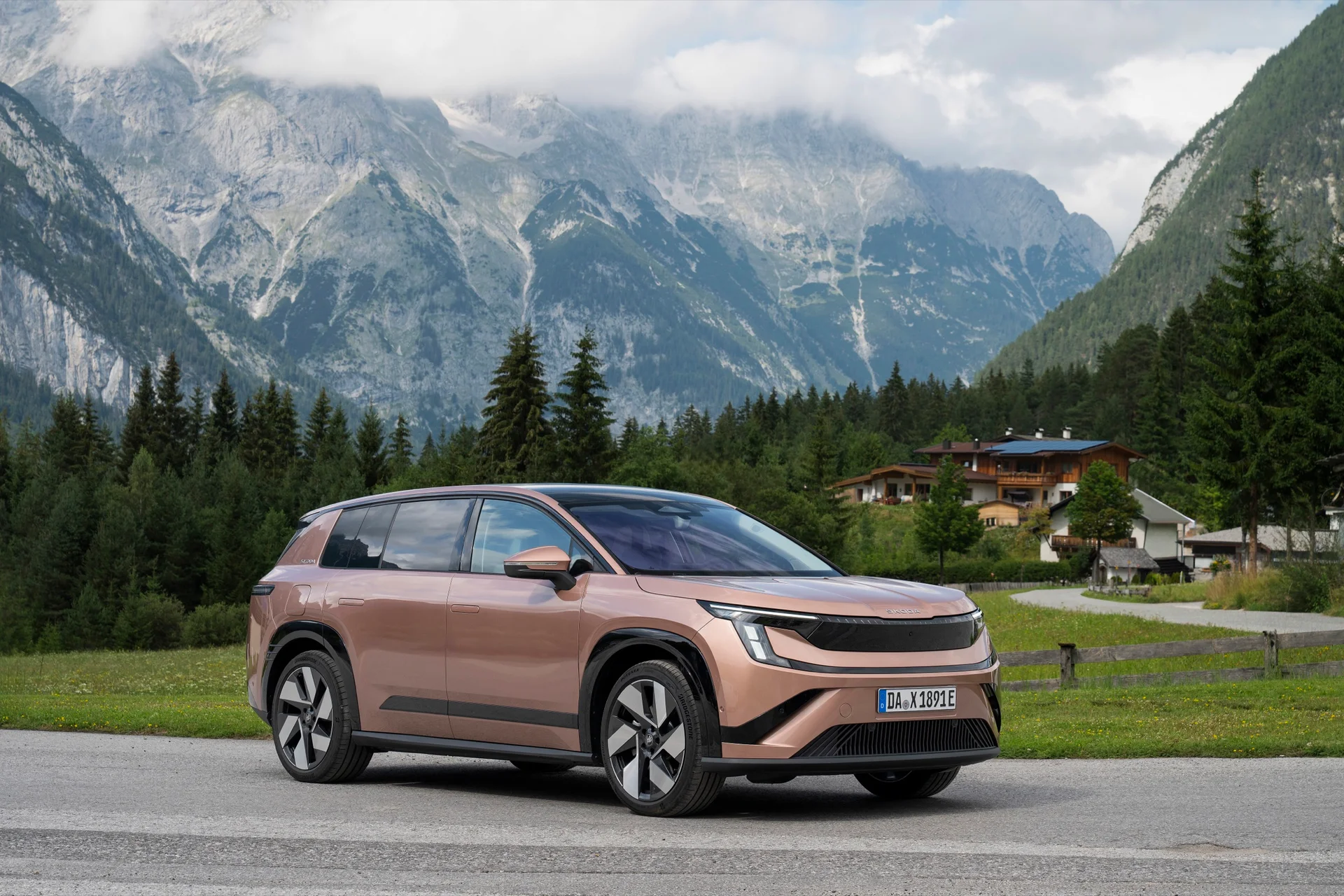
At 4,874 mm long, the Peaq is 116 mm longer than a Kodiaq, and its 2,965 mm wheelbase is longer than a Superb's by 124 mm. It's 1,867 mm wide and 1,664 mm tall, so it won't feel enormous in a car park, and the turning circle can be as tight as 9.9 m.
The boot is the big selling point. Five-seat cars have 935 litres, the largest of any Skoda, and 2,150 litres with the rear seats folded. In a seven-seater you get 299 litres with every seat up, 890 litres with the third row folded and 2,075 litres with both folded, and all versions have a 37-litre front boot for the cables. The sliding second row lets you trade boot space for legroom, and the third row has 961 mm of headroom.
Towing is up to 1,800 kg on the 60 and 90, and 2,000 kg on the 90x, with a tow bar as an option. ISOFIX mounts are on the outer second-row seats and the front passenger seat.
Tech and equipment
Every Peaq gets a 13.6-inch vertically mounted touchscreen running Android-based software with Google search for places and more than 150 apps, along with a 10-inch digital instrument display. Depending on trim and packages you also get a voice link between front and rear seats, Qi2 wireless charging for two phones at up to 25 W each and a digital key for compatible phones.
The upgrade most people will want is the Relax Package, which is available with every interior. It adds electrically adjustable, AGR-certified front seats with massage and legrests, ventilation in Suite interiors, a folding table and a 16-speaker, 755 W Sonos system. The panoramic roof, the largest Skoda has made at over 2.1 square metres, can darken in nine separate segments, but it's currently a Sportline-only option.
Safety
The Peaq hasn't been tested by Euro NCAP yet. Standard kit is thorough: ten airbags including a centre airbag, plus Front Assist, Crossroad Assist, Turn Assist, Lane Assist, Side Assist with exit warning, and predictive adaptive cruise control. Optional Travel Assist 3.0 adds assisted lane changes on multi-lane roads above 90 km/h, along with the ability to stop at red traffic lights.
Rivals
The closest on price is the Peugeot E-5008, from €55,995 in Ireland, with up to 673 km from its 97kWh battery.
The Hyundai Ioniq 9 is the bigger, more expensive option, from €78,495 in Ireland and £64,995 in the UK, with up to 620 km. The Kia EV9 costs more again, from €85,500 in Ireland and £66,645 in the UK, with up to 563 km (349 miles in the UK).
(Rival prices at launch or latest available: Ioniq 9 Irish price July 2025, UK January 2026; EV9 from Kia's Irish and UK sites, November 2026.)
Our verdict
The Peaq makes a very strong case for itself on price and space. If you need seven seats occasionally and want a car that can do long trips without much planning, the 90 is the one to buy, with a very long range and a boot that's huge when the third row is down. Road tests suggest it's also a calm and comfortable thing to live with.
If adults will regularly use the third row, look at the bigger Kia EV9 and Hyundai Ioniq 9 first, and expect to pay a lot more for them.
Strengths
- Far cheaper than the EV9 and Ioniq 9
- Up to 642 km of WLTP range
- 935-litre boot in five-seat form
- Quiet and comfortable, according to road tests
Weaknesses
- Third row is tight for adults
- Heat pump and third row are extra in some markets
- Misses SEAI and UK Electric Car grants
- Not yet tested by Euro NCAP
FAQs
Does the Skoda Peaq qualify for the Electric Car Grant? No. The UK grant only covers cars up to £37,000, and the Peaq starts at £51,980. It also misses the Irish SEAI grant, which stops at €50,000.
Is the Skoda Peaq a proper seven-seater? Yes, though seven seats depend on the market. They're standard in France and a €990 option in Germany. The third row suits children and smaller adults best, according to road tests.
How big is the Skoda Peaq's boot with seven seats up? 299 litres with all seven seats in place, rising to 890 litres with the third row folded and 2,075 litres with both rear rows folded.