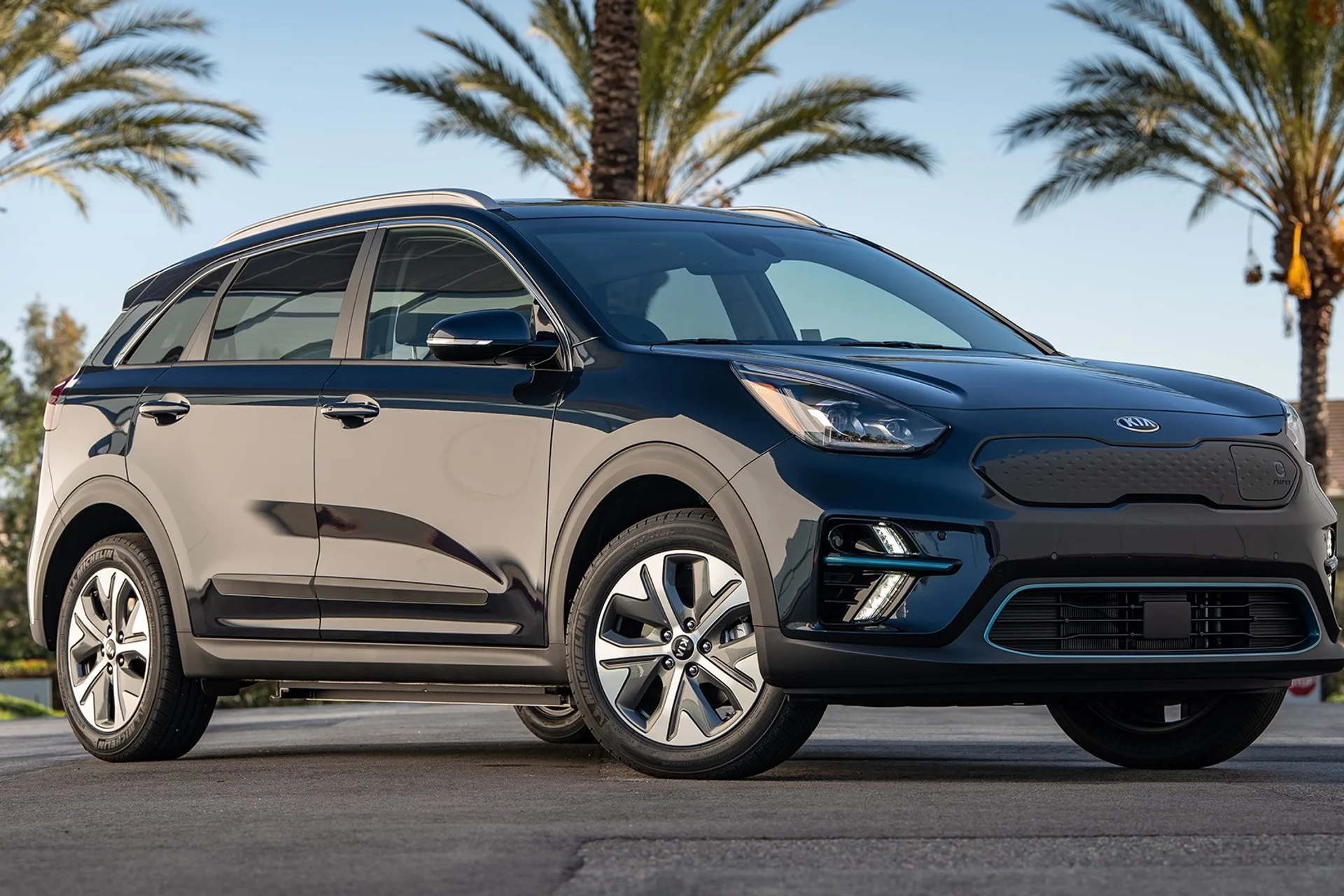
Which years and versions
Kia revealed the e-Niro in 2018, and European orders opened at the end of that year, with both batteries on offer from the start. The 64 kWh version is the one most people bought, and the one you'll find most of on the used market. Early Kia material quoted 485 km for it before the car's final homologation; the official WLTP figure is 455 km, so treat an advert quoting 485 km as optimistic. The 39 kWh car was always the cheaper, less powerful choice, and in some markets, the UK among them, it only arrived in 2020.
The main update came for model year 2020, at the start of that year. Kia replaced the old 7-inch and 8-inch navigation screens with a 10.25-inch system with online services (UVO Connect, with seven years of free use from first registration), redesigned the dashboard and the LED tail-light graphics, and added traffic sign recognition on higher trims. The same update brought an optional 10.5 kW three-phase on-board charger in markets such as Germany, so a 2020-on car can charge faster from a three-phase wallbox or public AC post than an early one. You can tell the updated car by the wider, tablet-style screen in the middle of the dashboard.
The heat pump is the option worth looking for. At launch in some markets, it was standard on every 64 kWh car; in others, it came on higher trims or as an option, alongside a battery preheating system. It saves range in cold weather because it uses less energy to heat the cabin, so check the specification or ask the seller. Dutch adverts often list it as "warmtepomp".
Trim names vary by market: Edition 7, Vision and Spirit in Germany, for example, and 2, 3, 4+ and First Edition in the UK. Even the basic versions came with adaptive cruise control, automatic emergency braking with pedestrian detection and lane-keeping assistance. The e-Niro was replaced by the second-generation Kia Niro EV in 2022, which has a 64.8 kWh battery and a completely different body, so don't confuse the two in adverts.
Battery, range and charging
Both batteries are lithium-ion polymer packs, and Kia quotes the same 54 minutes for a 0-80% charge on a 100 kW charger for each. In practice, the e-Niro is not a fast-charging car by today's standards: the 64 kWh version's charging speed peaks well below 100 kW, so a long trip with several stops takes patience. The 39 kWh car charges more slowly still. Every e-Niro uses a CCS socket, so it works at any modern charging hub.
Where the e-Niro does well is efficiency. Kia's official consumption for the 64 kWh car is 15.9 kWh per 100 km, which helps it get close to its official range in mild weather. Independent real-world estimates put the bigger battery at around 375 km in mixed driving, and less in winter, especially on cars without the heat pump.
The batteries have aged well on the evidence of the used market. Many dealers now list a state-of-health figure, and cars with more than 100,000 km often show 94-100%. That's no guarantee for any one car, so ask for a battery health report from a Kia dealer before you buy, or check it with an OBD reader and an app.
Warranty
Every e-Niro came with Kia's seven-year warranty, and it covers the battery too. In most of Europe the limit is seven years or 150,000 km, whichever comes first, and Kia guaranteed that the battery would keep at least 70% of its capacity during that time. In the UK, the warranty runs for seven years with unlimited mileage for the first three and a 100,000-mile limit after that, and it transfers to later owners.
That means a car first registered in 2019 is now out of warranty, a 2020 car loses its cover during 2027, and the last cars from 2022 are covered until 2029. Check the mileage too: plenty of used e-Niros have done well over 150,000 km, especially former taxis and company cars, and their warranty has ended regardless of age. A full Kia service history matters, because the warranty can depend on it.
Common problems and recalls
The biggest issue to check is the recall Kia announced in August 2026. It covers about 14,117 first-generation e-Niros built between 19 May 2020 and 18 March 2022, 11,331 of them in Europe. Kia says the battery management system's monitoring logic can, in some conditions, limit control of the high-voltage battery, which can overheat the cells and raise the risk of fire, while driving, charging or parked. The fix is a software update of about 30 minutes, plus an inspection of the battery, and if damage is found, the whole battery pack is replaced free of charge. Kia says it knows of no damage or injuries linked to the fault.
Beyond that, the e-Niro has a good record. It was the highest-rated mass-market EV in J.D. Power's first Electric Vehicle Experience ownership study in 2021, a survey of nearly 10,000 owners in the US, where the car was sold as the Niro EV. With no engine oil, clutch or exhaust, there's less to wear out, but check for the usual faults on any older EV: brake discs that rust because regenerative braking does most of the stopping, and a tired 12-volt battery, which can stop the car from starting.
To check a car's recalls, enter the registration in the GOV.UK recall checker in the UK; elsewhere, ask a Kia dealer to check the VIN. Euro NCAP tested the Niro in 2016 as a hybrid and gave it four stars as standard and five with the optional safety pack. The e-Niro wasn't tested on its own, though it has the automatic emergency braking from that pack as standard.
What to check before you buy
- Recall work. On a car built from May 2020 to March 2022, ask for proof the battery management update and battery inspection have been done.
- Battery health. Ask for a state-of-health report from a Kia dealer, or read it with an OBD reader.
- Battery size. Confirm 39 kWh or 64 kWh from the paperwork, and don't confuse it with the later 64.8 kWh Niro EV.
- Warranty left. Check the first registration date, the mileage and the service history.
- Heat pump. Look for it in the specification if you drive a lot in winter.
- On-board charger. Check for the three-phase 10.5 kW charger on 2020-on cars if you'll charge from three-phase AC.
- Infotainment. Make sure the screen, maps and phone connection work properly.
- Tow bar. Early cars weren't approved for towing, so check the paperwork if you need one.
- Brakes and 12-volt battery. Look for rusty discs, and ask when the 12-volt battery was last replaced.
- Charging cables. Check which cables come with the car.
Running costs and tax
The e-Niro is cheap to run. At a home electricity rate of 30 cent per kWh, a full charge of the 64 kWh battery costs about €19, or about €12 for the 39 kWh car, and less on an off-peak EV tariff.
In the UK, electric cars registered between April 2017 and March 2025 pay the standard rate of vehicle tax, £200 a year, and the expensive car supplement only applies to electric cars registered from April 2025, so every e-Niro pays the standard rate. In Ireland, electric cars pay the lowest motor tax rate, €120 a year. A car that's already registered in Ireland has paid its VRT. An import pays VRT when it's first registered, based on Revenue's valuation of the car, and electric cars get relief of up to €5,000 (see our article on VRT relief for electric cars). The e-Niro was built in South Korea, so a private import from Great Britain will also pay customs duty and 23% VAT: get the full cost from Revenue before you buy.
Prices
What moves an e-Niro's price most is the year and the mileage rather than the trim, and the 64 kWh car dominates the market everywhere. The 39 kWh car is rare, and in the UK it often costs the same as a 64 kWh car or more, because the smaller-battery cars are younger and have done fewer miles. The cheapest way in is a high-mileage 2020-2021 64 kWh car, but check how much of its warranty is left.
| Version | Ireland | Germany | Netherlands | France | UK |
|---|
| 39 kWh (2019-2022) | Few for sale | Few for sale | €17,000-€20,000 | Few for sale | £12,500-£18,000 |
| 64 kWh (2019-2020) | €14,000-€20,000 | €18,000-€24,000 | €17,000-€24,000 | Few for sale | £9,000-£15,000 |
| 64 kWh (2021-2022) | €14,000-€23,000 | €21,000-€26,000 | €20,000-€27,000 | Few for sale | £10,500-£17,500 |
(Rough asking-price ranges from dealer and private listings, November 2026. Mileage, condition and how you pay, whether a trade-in, finance or cash, can all move the final price. Irish prices are for cars already registered in Ireland; UK prices leave out the cost of importing, covered under Running costs and tax.)
Alternatives
The Hyundai Kona Electric of 2018-2023 is the e-Niro's closest relative, with the same 39 kWh and 64 kWh batteries and 150 kW motor in a smaller body. It's sportier to look at, but its boot and rear seats are smaller, and the first-generation Kona Electric has had battery recalls of its own. The current model is in the EV database as the Hyundai Kona Electric.
The Volkswagen ID.3 is a newer design, with faster charging on most versions and a rear-wheel-drive platform. Prices for a 58 kWh car overlap with a 64 kWh e-Niro, and the battery warranty is eight years or 160,000 km (see our used Volkswagen ID.3 guide).
The Nissan Leaf e+, with its 62 kWh battery, is the other long-range family hatchback of these years, but its battery is air-cooled and it uses the CHAdeMO plug, which many new charging hubs don't have (see our used Nissan Leaf (2018-2025) guide).
Which one to buy
For most buyers, the best used e-Niro is a 64 kWh car from 2020 or 2021 with the heat pump, a full Kia service history and the recall work done. It has the newer 10.25-inch screen on higher trims, the option of three-phase charging, and enough warranty left to cover the battery for a while yet, as long as the mileage is under the limit.
A 2019 car is fine if the price reflects its lack of warranty, and a 39 kWh car only makes sense if you rarely drive far and find one cheaper than a 64 kWh car, which is less common than you'd think. If you'd rather have something newer, Kia's current small electric SUV is the Kia EV3, and our guide to buying a used electric car covers the checks for any EV.
FAQs
Is a used Kia e-Niro a good buy?
It's one of the more sensible used EVs: roomy, efficient, and with up to 455 km of official range in the 64 kWh version. Check that a car built from May 2020 to March 2022 has had its battery recall work done, and how much of the seven-year warranty is left.
Does the Kia e-Niro battery warranty transfer to a new owner?
Yes. Kia's seven-year warranty stays with the car and covers the battery, with a guarantee that it keeps at least 70% of its capacity. The limit is 150,000 km in most of Europe and 100,000 miles in the UK, so a high-mileage car can lose its cover early.
Is the Kia e-Niro affected by a battery recall?
Cars built between 19 May 2020 and 18 March 2022 are, under a recall announced in August 2026 for a battery management fault that can raise the fire risk. A Kia dealer updates the software and inspects the battery, and replaces the pack free of charge if it finds damage.