Which years and versions
The first Leaf reached European buyers in 2011, built in Oppama, Japan, with a 24 kWh battery and a range of 175 km on the old NEDC test. In March 2013 European production moved to Nissan's Sunderland plant in England, with a battery plant alongside, and the car that came out of it was improved in dozens of small ways. Every European Leaf from mid-2013 onwards was built there.
The 2013 update is the one to look for if you're buying a 24 kWh car. NEDC range rose to 199 km, helped by better regenerative braking and a car up to 50 kg lighter. A heat pump replaced the old ceramic heater, cutting the energy the heater uses by up to 70%, which makes a real difference to range in winter. The charger moved from the boot to the front of the car, freeing up 40 litres of luggage space, and an optional 6.6 kW on-board charger halved the time to charge at a wallbox, from about eight hours to about four. The range was split into three trims, Visia, Acenta and Tekna.
From the outside the two are hard to tell apart, so go by the registration date, and check the boot: on the early car, the charger sits in the boot, under a raised section of floor. The trims are easier. Visia cars have steel wheels and halogen headlights, and the CHAdeMO rapid-charging socket was standard on Acenta and Tekna but not on every Visia, so check for the second, larger socket in the nose.
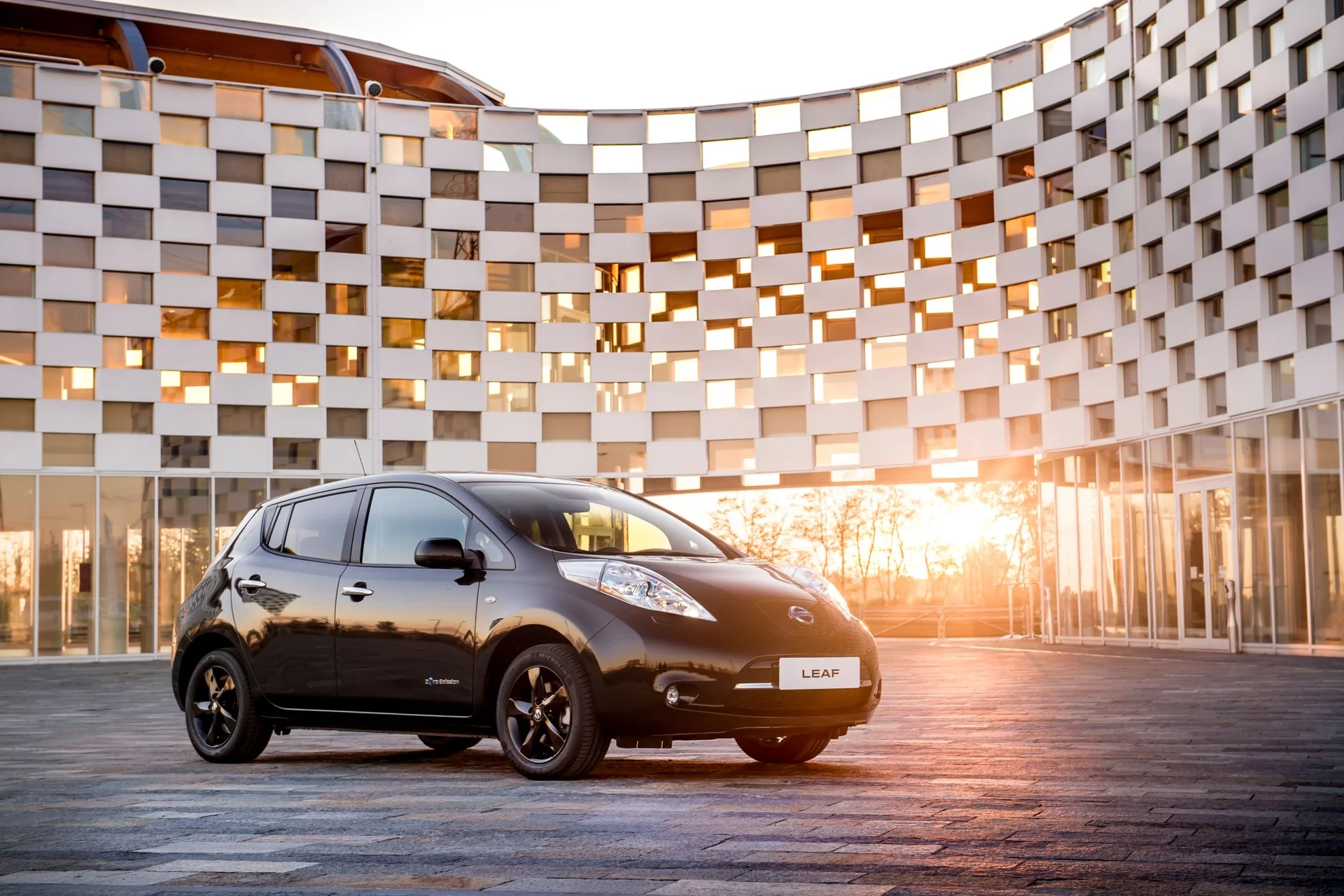
The 30 kWh battery arrived in January 2016, on Acenta and Tekna versions. It fits in the same space, weighs only 21 kg more and raised the NEDC range to 250 km, about a quarter more than the 24 kWh car. The 2016 cars also got NissanConnect EV in place of the old Carwings system, with a 7-inch touchscreen on Acenta and Tekna. Look for the 30 kWh badge, or check the battery size on the paperwork, because adverts often get it wrong. Special editions included the Black Edition of late 2016, based on the Acenta. The second-generation Leaf replaced the car in early 2018 (see our used Nissan Leaf (2018-2025) guide).
Battery, range and charging
Like the later Leaf, the first generation has an air-cooled battery with no liquid cooling or heating. Heat speeds up its ageing, and so does frequent rapid charging, so some cars have lost far more capacity than others of the same age.
The Leaf makes this fairly easy to check. Next to the charge meter on the dashboard is a separate gauge of 12 small bars showing how much capacity the battery has left. A car with all 12 has kept most of its capacity, and every missing bar means noticeably less range. Nissan's own warranty treated a drop below 9 bars as excessive capacity loss, which is a useful line: a car showing 8 bars or fewer has a battery Nissan considered worn. For a precise reading, ask a Nissan dealer for a state-of-health report, or use an app with a Bluetooth OBD reader, which shows the exact percentage.
Rapid charging is through CHAdeMO, the Japanese standard most of Europe has since moved away from. Plenty of older charging sites still have a CHAdeMO cable, but many new hubs offer only CCS, so check the chargers you'd use before you buy. Nissan quoted around 30 minutes for 0-80% on a 50 kW charger, but the battery heats up on a long day, and repeated rapid charges on the same trip slow down. In practice, a first-generation Leaf works best as a car you charge at home and drive locally.
At home, the 6.6 kW charger matters. A car with only the standard 3.3 kW unit takes about eight hours to charge fully, while the 6.6 kW unit does it in about four on a wallbox that supports it. Not every car has it, so check the specification or ask the seller.
Battery lease: check before you buy
From April 2013, Nissan offered the Leaf with its battery leased rather than bought, in most European markets but not Ireland. The car cost about €5,900 less up front, and the owner paid a monthly fee for the battery: in the euro zone, from €79 a month for 12,500 km a year on a three-year term, up to €142 a month for 25,000 km on a one-year term. In the UK, leased-battery cars were sold as Flex versions. In return, the lease came with a guarantee that the battery would keep a set level of capacity for as long as it was leased.
A used car with a leased battery isn't necessarily a bad buy, but it changes the sums. You'd take over the monthly payments, which can quickly cost more than the car itself, or buy the battery out. That's why the cheapest Leafs in the adverts are often leased-battery cars. Ask the seller in writing whether the battery is owned or leased, and confirm it with Nissan or the finance company using the registration number. Many sellers state it in the advert: "owned battery" in the UK, "mit Batterie" in Germany or "incl. accu" in the Netherlands.
Warranty
Every first-generation Leaf is now out of its battery warranty. The 24 kWh battery was guaranteed for five years or 100,000 km to keep at least 9 of its 12 capacity bars, a cover Nissan added retrospectively for the early cars in June 2013. The 30 kWh battery had an eight-year or 160,000 km capacity warranty, so even a car registered in early 2018 lost that cover by early 2026.
The rest of the car's warranty ran out long ago too, so any battery repair is at the owner's cost, which is why the capacity gauge and a health report should decide what you pay.
Common problems and recalls
The Leaf's motor and electronics have a good record, and with no engine oil, clutch or exhaust, there's less to wear out than on a petrol car of the same age. Beyond the battery, the faults to look for are the usual ones on an older EV: brake discs that rust because the regenerative braking does most of the stopping, and a weak 12-volt battery, which can stop the car starting.
A Nissan dealer can check whether a car's recall and campaign work has been done. In the UK, enter the registration in the GOV.UK recall checker; elsewhere, ask a franchised dealer with the VIN. The Leaf scored five stars from Euro NCAP when it was tested in 2011, though the tests have become much stricter since.
What to check before you buy
- The capacity gauge. Count the bars next to the charge meter: 12 is ideal, and 8 or fewer means a worn battery.
- Battery health report. Ask for a state-of-health percentage from a Nissan dealer or an OBD reading.
- Owned or leased battery. Get it in writing, and confirm with Nissan or the finance company.
- Battery size. Confirm 24 kWh or 30 kWh from the paperwork, not just the advert.
- Early or updated car. Check the registration date and look for the charger unit in the boot of 2011-2013 cars.
- On-board charger. Check for the 6.6 kW unit if you'll charge at home.
- Rapid-charging socket. Make sure a Visia has the CHAdeMO socket if you need it.
- Range at full charge. Charge it to 100% and see what the car shows, allowing for weather and driving style.
- Brakes and 12-volt battery. Look for rusty discs, and ask when the 12-volt battery was replaced.
- Charging cables. Check which cables come with the car.
Running costs and tax
The Leaf is cheap to run. At a home electricity rate of 30 cent per kWh, a full charge of a 24 kWh battery costs about €7, or about €9 for the 30 kWh car, and less on an off-peak EV tariff.
In the UK, electric cars registered before April 2017 pay band A vehicle tax, £20 a year, while a Leaf registered from April 2017 pays the standard rate of £200. In Ireland, electric cars registered between 2008 and 2020 pay the lowest motor tax rate, €120 a year. A car that's already registered in Ireland has paid its VRT, but an import pays it when it's first registered, based on Revenue's valuation of the car, and electric cars get relief of up to €5,000. The relief applies to cars registered before the end of 2026, and Budget 2027 extends it to the end of 2028, subject to EU approval (see our article on VRT relief for electric cars). A private import from Great Britain also pays VAT at 23% on arrival, and customs duty too unless the car qualifies as UK-made under the EU-UK trade agreement, so check with Revenue first: Sunderland-built cars from 2013 may, the Japanese-built cars won't.
Prices
Here, the price follows the battery more than the year. A 30 kWh car with healthy bars costs more than an early 24 kWh car, but within each version, a missing bar or a leased battery can take a big slice off. The UK has by far the most for sale, and the lowest prices, while in France and Germany the first-generation car has almost disappeared from the market.
| Version | Ireland | Germany | Netherlands | France | UK |
|---|
| 24 kWh (2011-2013) | €2,000-€3,000 | Few for sale | €3,500-€6,000 | Few for sale | £1,500-£3,500 |
| 24 kWh (2013-2017) | €3,000-€4,500 | Few for sale | €5,000-€6,500 | Few for sale | £2,000-£4,500 |
| 30 kWh (2016-2017) | €4,000-€6,500 | €7,000-€9,000 | Few for sale | Few for sale | £2,500-£4,500 |
(Rough asking-price ranges from dealer and private listings, November 2026. Mileage, condition and how you pay, whether a trade-in, finance or cash, can all move the final price. Irish prices are for cars already registered in Ireland; UK prices leave out the cost of importing, covered under Running costs and tax.)
Alternatives
The Renault Zoe of the same years is the Leaf's closest rival at this money. Its fast AC charging, 22 kW or more, is far quicker at a public charge point, but many early Zoes were sold with a leased battery, and rapid charging wasn't available on most versions. Its later Z.E. 50 is covered in our used Renault Zoe Z.E. 50 guide.
The Volkswagen e-Golf, from 2014, looks and drives like any other Golf and uses CCS for rapid charging, which is easier to find at new hubs than CHAdeMO. Used prices are usually higher than a Leaf's.
The BMW i3, also from 2013, is smaller and lighter, with a carbon-fibre passenger cell and CCS charging, but only four seats and a higher price.
Which one to buy
For most buyers, the best first-generation Leaf is a 30 kWh Acenta or Tekna with all 12 capacity bars, the 6.6 kW charger and an owned battery. It goes furthest, it has the newer infotainment, and it's young enough that the battery has had less time to age.
On a tight budget, a 2014-2015 24 kWh Acenta with a healthy battery is fine for short daily trips and home charging, and it has the heat pump and updated cabin the early cars lack. Avoid the 2011-2013 cars unless the price reflects their shorter range and older layout. Whichever you choose, the battery report matters more than anything else, and the second-generation Leaf is worth a look if you can stretch your budget. For a brand-new car, the new Nissan Leaf is a crossover with CCS charging (see the Nissan Leaf specs), and our guide to buying a used electric car covers the checks for any EV.
FAQs
Is a used first-generation Nissan Leaf worth buying?
It can be, as a cheap car for local driving with home charging. Check the 12-bar capacity gauge and get a battery health report, make sure the battery is owned rather than leased, and price in the short range: even when new, the official figure was 199 km for the 24 kWh car and 250 km for the 30 kWh.
What's the difference between the 24 kWh and 30 kWh Leaf?
The 30 kWh battery, from 2016, raised the official NEDC range from 199 km to 250 km, and came on Acenta and Tekna versions with a newer 7-inch touchscreen system. The 30 kWh car also had a longer battery warranty, eight years or 160,000 km against five years or 100,000 km, though both have now run out.
Does a used Nissan Leaf have a battery lease?
Some do. From 2013 Nissan offered the battery on lease in most European markets, but not Ireland, and UK leased-battery cars were sold as Flex versions. Ask the seller in writing and confirm with Nissan or the finance company, because you'd have to take over the monthly payments or buy the battery out.