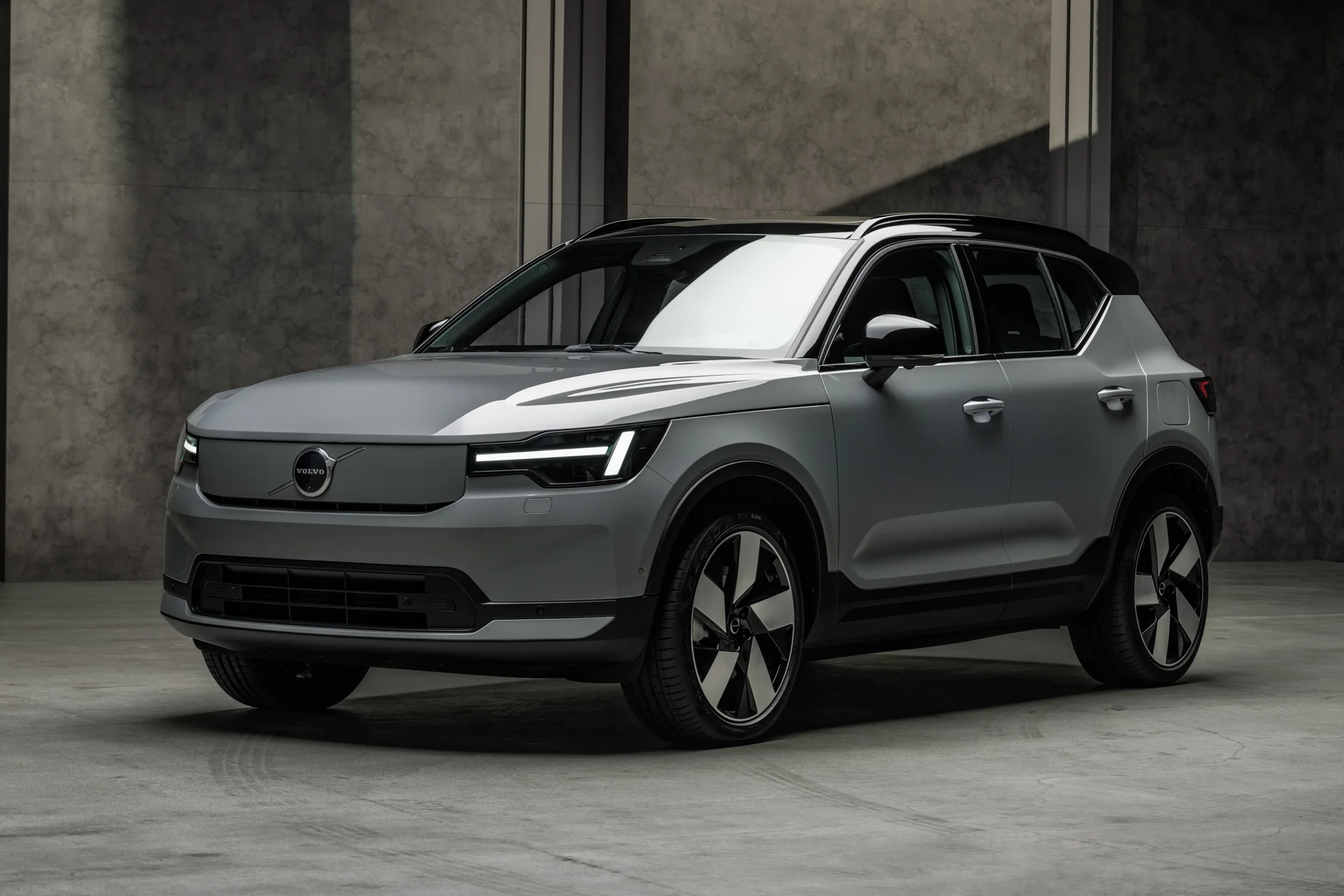
Prices and trims
Which versions you can buy depends on where you live. Germany and France get the entry P5, the P5 Long Range and the new 325 kW P8 Performance. The Netherlands gets all four, Ireland keeps the 300 kW P8 AWD instead of the Performance, and the UK range starts with the P5 Long Range.
| Market | P5 | P5 Long Range | P8 AWD | P8 Performance AWD |
|---|
| Netherlands | €40,995 | €46,995 | €48,995 | €53,995 |
| France | €46,950 | €52,700 | Not sold | €62,900 |
| Germany | €47,490 | €53,090 | Not sold | €60,590 |
| Ireland | €48,460 | €54,485 | €67,635 | Not sold |
| UK | Not sold | £43,860 | £47,860 | Not sold |
(Prices from Volvo's national websites, correct at 18 November 2026. Each is the cheapest trim available with that powertrain. Grants may apply: the SEAI grant in Ireland, plus national schemes elsewhere. The EX40 costs more than the £37,000 limit for the UK's Electric Car Grant. Delivery and dealer charges are extra.)
The Dutch prices stand out. The same P5 costs €6,495 less in the Netherlands than in Germany, and the P8 AWD there is only €2,000 more than the P5 Long Range, so the twin-motor car costs far less of a premium than it does elsewhere.
Trim names vary a little by market. In Ireland, the range opens with Plus, which brings keyless entry with a hands-free power tailgate, wireless phone charging and upgraded interior lighting. Plus Pro adds the 360-degree camera with its new 3D view, side parking sensors, Pilot Assist and an air purifier that can clean the cabin air remotely before you get in. Ultra adds a panoramic roof and a gloss-black roof, and Ultra Pro adds a Harman Kardon sound system and a powered passenger seat. Germany adds cheaper Essential and Core trims below Plus, plus Black Edition versions with dark exterior trim.
The EC40 alternative
The EC40 is the same car with a lower, sloping roof, 56 mm lower overall. It costs a little more, from €45,495 in the Netherlands and £45,860 in the UK, and the more aerodynamic shape gives it slightly more range: 486 km for the P5 and 582 km (359 miles) for the P5 Long Range. The price is paid in headroom and boot space. Rear headroom drops from 974 mm to 932 mm, and the boot shrinks from 410 to 404 litres to the parcel shelf, or from 1,400 to 1,310 litres with the seats folded.
Battery, range and charging
Volvo quotes nominal battery capacities rather than usable ones: 70kWh for the P5 and 82kWh for everything else. The P5's 477 km (296 miles) of WLTP range is 10 km more than the outgoing entry model managed. That's enough for most weekly commuting on one charge, but on a long motorway run in winter you'd expect a good deal less.
If you regularly do long trips, the P5 Long Range is the version to look at. It's the most efficient EX40, at 16.6 kWh/100 km, and its 573 km (356 miles) makes it the longest-range car in the range. Volvo UK quotes up to 354 miles for the UK-spec car. The twin-motor cars give away surprisingly little, at 537-539 km despite their extra motor and power.
Volvo quotes 10-80% in 26 minutes for the 70kWh battery and 28 minutes for the 82kWh battery, both on a 200 kW charger. That's competitive for this class, though not class-leading: Kia's 800-volt EV6 does the same job in 18 minutes. At home, the EX40 charges at up to 11 kW on a three-phase supply, which takes seven hours from empty for the P5 and eight for the 82kWh cars. Plug & Charge is standard, and you can set a charger as a destination in the Google Maps navigation so the battery is warmed up for faster charging on arrival.
Volvo recommends charging to 90% day to day for long-term battery health.
Performance
Even the cheapest EX40 is quicker than most buyers need. The rear-drive P5 has 175 kW (238 hp) and 420 Nm and does 0-100km/h in 7.3 seconds, and the P5 Long Range adds 10 kW without changing that time. Both are limited to 180 km/h.
The twin-motor P8 AWD has 300 kW (408 hp) and 670 Nm, enough for 0-100km/h in 4.8 seconds. The new P8 Performance AWD, sold in Germany, France and the Netherlands, gets 325 kW (442 hp), with 135 kW at the front and 190 kW at the rear, and takes 0-100km/h down to 4.6 seconds. That's hot-hatch pace in a family SUV, though the top speed stays at 180 km/h.
Weight ranges from 2,040 kg for the P5 to 2,170 kg for the P8 versions. Volvo's all-wheel-drive models can also tow more: 1,800 kg rather than 1,500 kg.
Driving and comfort
The EX40 is set up for comfort and calm rather than sportiness. You can choose one-pedal driving, which uses strong regenerative braking to bring the car to a stop when you lift off, and the power steering is adaptive. This update leaves the chassis alone and concentrates on the new sensor platform and software, which Volvo says makes Pilot Assist follow the road more smoothly on longer motorway runs.
Road tests of the electric XC40 and EX40 have generally agreed on the same points. It's quiet and refined at speed, and the seats and driving position earn praise. The ride is usually described as firm, especially on the larger wheels, with some fidgeting over poor surfaces. The twin-motor versions are very quick in a straight line, but the handling is safe and predictable rather than engaging.
If you want comfort, the P5 versions on smaller wheels make the most sense. The P8s are for people who want the performance and the extra towing capacity.
Size and practicality
At 4,440 mm long, 1,873 mm wide and 1,647 mm high, the EX40 is a compact SUV, about the size of a Skoda Elroq. The wheelbase is 2,702 mm, and rear legroom is 917 mm, which is fine for adults on shorter trips but not generous.
The boot holds 410 litres to the parcel shelf, 536 litres loaded to the roof and 1,400 litres with the rear seats folded. There's a 31-litre front boot for the charging cables. Those numbers are on the small side for the class: the Elroq has 470 litres and the Toyota C-HR+ 416 litres.
Towing is 1,500 kg for the rear-drive cars and 1,800 kg for the AWD versions, both with a 75 kg roof load.
Tech and equipment
The biggest change inside is a new 11.2-inch centre touchscreen with Volvo's latest software, which Volvo says needs fewer taps to reach the functions you use most. It sits alongside a 12.3-inch driver display. Google built-in is standard, with Google Maps and the Play Store included for four years, and the voice assistant is now Google Gemini, which understands ordinary speech for planning trips, finding stops and handling messages. Apple CarPlay and Android Auto are standard too.
The wireless phone charger has been upgraded, and there are new upholstery and trim options, including Black Ash and aluminium decor. Over-the-air updates continue to add features after you buy the car.
Safety
The update brings a new set of safety hardware: new front and corner radars, a new front camera, rear corner radars, 12 ultrasonic sensors and new parking cameras. Together they support automatic emergency braking and steering, collision avoidance and a new Door Opening Alert, which warns you before you open a door into a passing cyclist. Pilot Assist adds lane change assist, and the 360-degree camera now has a 3D view.
Euro NCAP hasn't tested the facelifted car. The original XC40 scored five stars in 2018, and the C40 Recharge, now the EC40, scored five stars in 2022.
Rivals
| Car | Price from (Germany) | Battery (gross) | WLTP range | 10-80% | Boot |
|---|
| Volvo EX40 P5 | €47,490 | 70kWh | 477 km | 26 min | 410 litres |
| Skoda Elroq 85 | €44,180 | 82kWh | 577 km | 29 min | 470 litres |
| Toyota C-HR+ | €41,990 | 57.7kWh | 458 km | 28 min | 416 litres |
| Polestar 4 SUV | €57,900 | 100kWh | 630 km | 30 min | 530 litres |
(German list prices before grants. Volvo quotes nominal battery capacity.)
The Skoda Elroq is the obvious alternative: a similar size, a bigger boot and, in 85 form, a larger battery and more range than the entry EX40 for less money. The Volvo has the plusher cabin and the stronger safety reputation, but on paper the Skoda is better value.
The Toyota C-HR+ is cheaper again and charges at a similar speed, but its base 57.7kWh version gives up 19 km of range to the P5, while the bigger-battery C-HR+ costs more. See the Toyota C-HR+ specs.
The Polestar 4 SUV is the step up from within the same group. It costs about €10,000 more, but its 100kWh battery gives 630 km of range and it has a bigger boot, at 530 litres. See the Polestar 4 SUV specs.
Our verdict
The EX40 was already a comfortable, well-made compact SUV, and this update fixes what had dated: the screen, the lights and the safety hardware. The P5 Long Range is the pick for most buyers, with the best efficiency and range in the range. In the Netherlands, the P8 AWD's small price premium makes it tempting too.
Strengths
- 573 km of WLTP range from the P5 Long Range, more than the Toyota C-HR+'s 458 km
- 10-80% in 26-28 minutes, a little quicker than the Elroq's 29 minutes
- 325 kW P8 Performance does 0-100km/h in 4.6 seconds
- Google built-in, Gemini and a new 11.2-inch screen as standard
Weaknesses
- 410-litre boot trails the Elroq's 470 litres
- Entry P5 costs €3,310 more than an Elroq 85 in Germany, with less range
- Volvo doesn't publish usable battery capacity or peak charging power
- The facelifted car hasn't been crash-tested by Euro NCAP yet
FAQs
Does the Volvo EX40 qualify for the Electric Car Grant?
No. The cheapest UK EX40 costs £43,860, above the £37,000 price limit for the UK's Electric Car Grant.
What's the difference between the Volvo EX40 and the EC40?
The EC40 has a lower, sloping roof. It costs a little more and goes slightly further on a charge, up to 582 km in P5 Long Range form, but it has less rear headroom and a smaller boot: 404 litres rather than 410 litres, and 1,310 litres rather than 1,400 litres with the seats folded.
How fast does the Volvo EX40 charge?
Volvo quotes 10-80% in 26 minutes for the 70kWh P5 and 28 minutes for the 82kWh versions on a 200 kW DC charger. On an 11 kW home wallbox, a full charge takes seven hours for the P5 and eight hours for the others.