
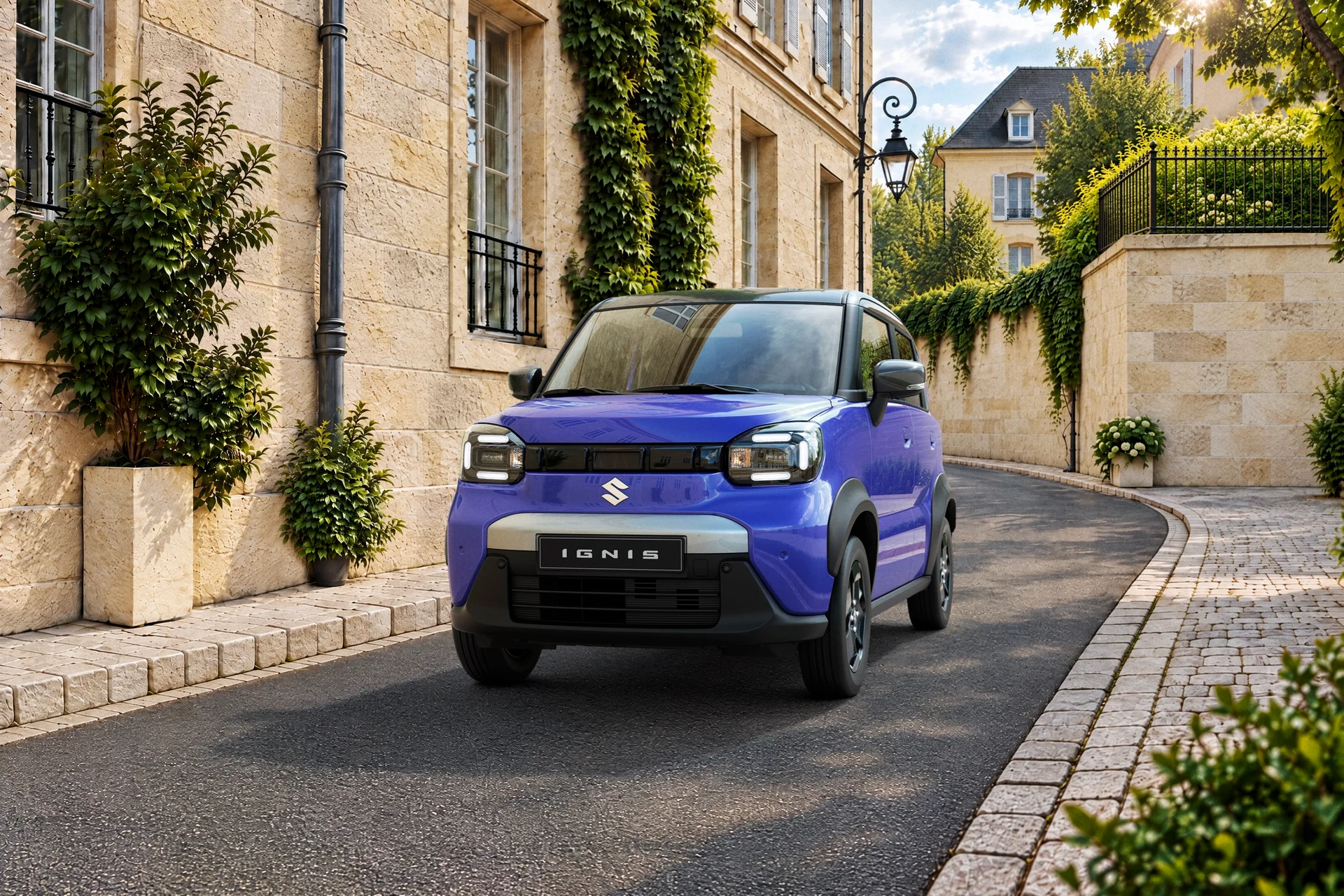
The Suzuki Ignis is back, and this time it's electric. Suzuki revealed its first compact EV on 25 November: a four-seat, five-door city car just 3.57 metres long, with a 26 kWh LFP battery and a 67 kW (91 PS) motor driving the front wheels. Sales begin in Europe and other markets from summer 2027.
It's a smaller car than most of the new wave of cheap European EVs. The electric Renault Twingo is 3.79 metres long and the Nissan Pixo 3.8 metres, so the Ignis is more than 20 cm shorter than both. That's the whole point of it: Suzuki pitches it as an easy switch for drivers moving out of a petrol car or down from something bigger.
Suzuki Ignis electric specs
Suzuki's European figures are pre-homologation, so they could still change, but the basics are set.
| Suzuki Ignis electric | |
|---|---|
| Battery | 26 kWh LFP |
| Power | 67 kW (91 PS) |
| Torque | 133 Nm |
| Drive | Front-wheel drive |
| Length | 3,570 mm |
| Width | 1,565 mm |
| Height | 1,635 mm |
| Wheelbase | 2,460 mm |
| Turning circle | 9.0 m |
| Seats | 4 |
(Pre-homologation figures from Suzuki, 25 November 2026.)
The turning circle is the stand-out figure. Suzuki quotes a minimum turning radius of 4.5 metres, tighter than the 4.7 metres of the last petrol Ignis, which was already known for being easy to park. The Pixo, by comparison, needs 9.9 metres to turn round. With 150 mm of ground clearance and tall 1,635 mm bodywork, it keeps the slightly raised, upright stance of the old car.
It's also expected to be very light, at about 1,080 kg. That would make it one of the lightest full-size EVs on sale in Europe, now that the sub-tonne first Dacia Spring has given way to a heavier second generation. Light weight and a small battery should mean modest energy use, but Suzuki hasn't published a range or efficiency figure yet, and it hasn't said how fast the Ignis charges either.