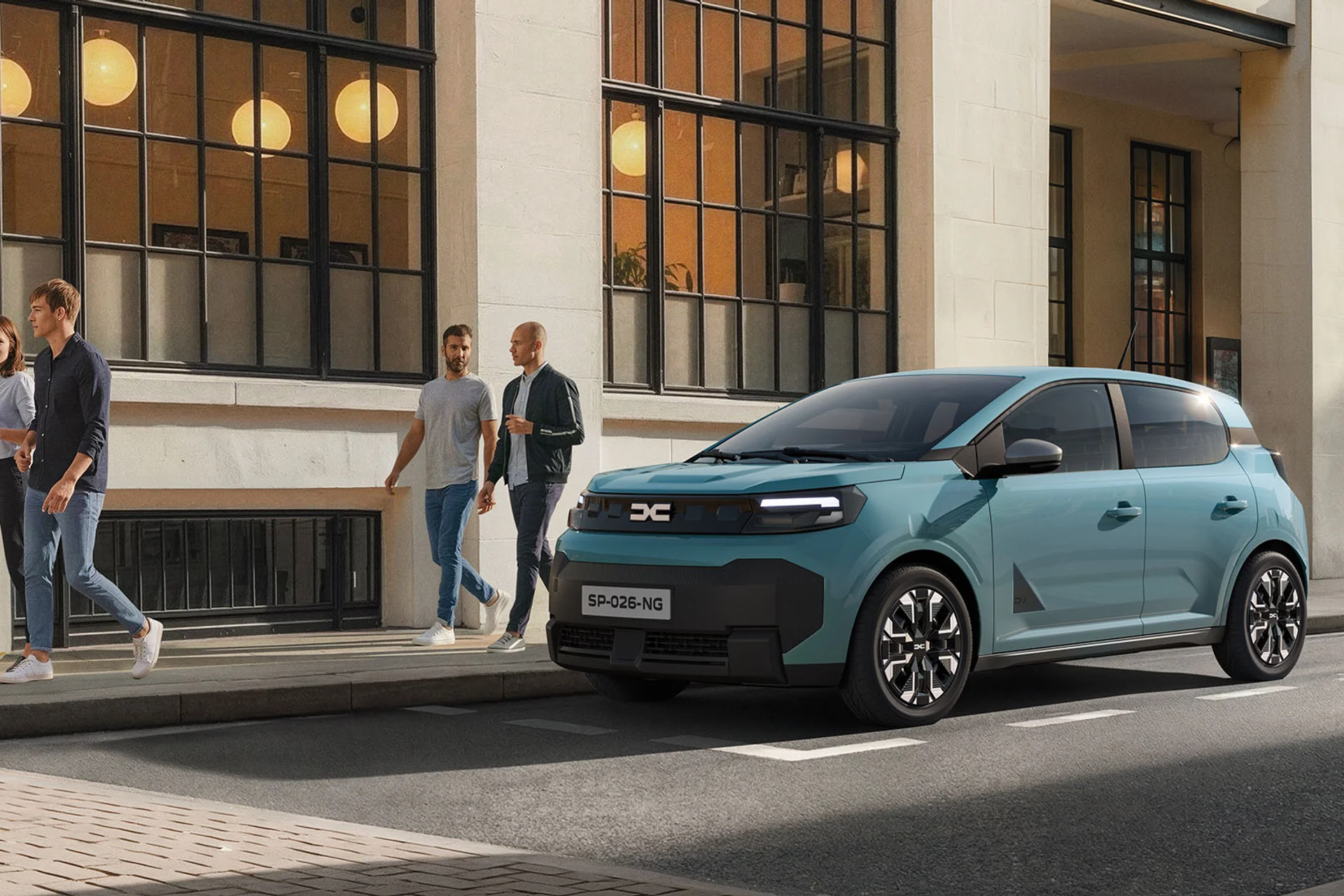
1. Dacia Spring
The Spring was already the car that made electric motoring cheap, and the new second-generation model, revealed in September, keeps that job at €17,900 in Germany. It's a much better car than the old one. It now sits on Renault Group's small EV platform, with a 60 kW (80 hp) motor, a 27.5 kWh LFP battery and a WLTP range of up to 250 km in the Journey trim (245 km for the entry Expression).
That range comes from efficiency rather than battery size: Dacia quotes 12.7 kWh/100 km, one of the lowest figures of any car on sale, helped by a kerb weight from just 1,212 kg. A 6.6 kW AC charger is standard. The Fast Charge Pack adds 11 kW AC and 50 kW DC charging, which takes the battery from 15% to 80% in 28 minutes, so tick that box if the car will ever leave town.
The Spring suits someone who drives mostly in and around a town and charges at home; Dacia says first-generation owners averaged 34 km a day. The drawbacks are the modest motorway pace (0-100km/h takes 12.1 seconds and it tops out at 130 km/h) and the fact that fast charging is an option. The new Spring isn't sold in Ireland. The UK still sells the previous Spring, from £11,990, and prices for the new one haven't been announced there.
2. Leapmotor T03
Source: Leapmotor / Dino Eisele
For €1,000 more than the Spring, the T03 gives you the biggest battery among the cheapest four: 37.3 kWh, good for a WLTP range of up to 275 km. It's a tall five-door city car, and its 70 kW (95 PS) motor gives it a little more urge than the Dacia and Renault.
Charging is where the price shows. The T03 takes up to 45 kW at a rapid charger, and Leapmotor quotes 36 minutes from 30% to 80%, which is slower than everything else here. That matters less than it sounds for a car that will spend most nights on a home charger, and the extra battery means fewer stops in the first place. Leapmotor quotes WLTP consumption of 15.7 kWh/100 km.
It's even better value in Ireland and the UK. The T03 costs €19,492 in Ireland after the SEAI grant and VRT relief (€24,575 before), the cheapest car in this list there, and £16,295 on the road in the UK, where Leapmotor is currently taking another £2,500 off.
Buy the T03 if you want the most range for the least money and rarely drive long distances. Leapmotor is sold and serviced through Stellantis in Europe, so it has a bigger dealer network than most new brands.
3. Renault Twingo E-Tech electric
The Twingo is back, and this time it's electric only and costs €19,990 in Germany. Underneath it shares a lot with the new Spring: a 60 kW (82 hp) motor and a 27.5 kWh LFP battery, built in the same factory in Novo Mesto, Slovenia. Renault Germany quotes a WLTP range of 262 km for the entry Evolution, and the Twingo weighs about 1,200 kg.
Renault's Advanced Charge pack adds an 11 kW AC charger, 50 kW DC charging and vehicle-to-load. With it, a rapid charger takes the battery from 10% to 80% in about 30 minutes. It's standard in some markets, including the Netherlands, so check what your version includes.
Where the Twingo earns its extra €2,090 over the Spring is in the cabin and the technology: Renault's OpenR Link system with Google built-in, more driver assistance and a design that looks like nothing else on the road. It's the one to pick if you want a city car that feels a little special. Irish and UK prices haven't been announced yet.
4. Citroën ë-C3
The ë-C3 is the cheapest car here that isn't a city car. It's a supermini-sized crossover with five proper seats, and the Urban Range version costs €20,140 in Germany, which is €310 less than the new ë-C3 Tonic special edition at €20,450. It starts at £18,495 in the UK, and Citroën Ireland quotes prices from €23,008 after the SEAI grant and VRT relief.
The Urban Range has a 30 kWh battery and a WLTP range of 212 km (132 miles), with 20-80% at a rapid charger in 36 minutes. That's the shortest range in the top ten, so the Standard Range version is worth a look: its 44 kWh battery gives 325 km (202 miles), and it charges at up to 100 kW, 20-80% in about 26 minutes. It costs €23,450 in Germany and £21,215 in the UK.
The ë-C3 suits buyers who want space and Citroën's soft, comfortable ride for the least money.
5. BYD Dolphin Surf
BYD's smallest European model starts at €23,490 in Germany, €19,685 in Ireland and £18,675 in the UK, which makes it one of the cheapest cars here outside mainland Europe. The Active has a 30 kWh Blade battery, a WLTP range of 220 km and DC charging at up to 65 kW, and it gets alloy wheels, a 10.1-inch touchscreen with navigation, Apple CarPlay and Android Auto as standard.
The Boost is the better buy if you can stretch to it. Its 43.2 kWh battery gives 322 km and charges at up to 85 kW, and it adds heated front seats and a heated steering wheel. It costs €27,490 in Germany and £21,975 in the UK.
Buy the Dolphin Surf if you want plenty of equipment for the money. BYD is also running offers on it in Germany, so the price you actually pay can be well below the list price.
6. Hyundai Inster
The Inster is the cheapest car here with more than 300 km of range. The entry Select costs €24,650 in Germany, although Hyundai says it's only available at participating dealers while stocks last; the Trend is €26,650. Both have a 42 kWh battery, a 71 kW (97 PS) motor and a WLTP range of 327 km. In the UK it starts at £22,995, but it isn't listed on Hyundai Ireland's website.
The 49 kWh versions go further, up to 360 km, or 370 km for the Prime on 15-inch wheels, with an 85 kW (115 PS) motor. They start at €29,850. Hyundai quotes 10-80% at a rapid charger in about 30 minutes.
What makes the Inster clever is its cabin. It's under 3.9 metres long, but the rear seats slide and every seat folds flat, so it can carry more than its size suggests. Buy it if you want a small car with a usable range and a cheerful design; the catch is that the cheapest version may be hard to find.
7. Volkswagen ID. Polo
Volkswagen's electric Polo starts at €24,995 in Germany, €25,990 in the Netherlands and £23,945 in the UK. In Ireland it's €19,885 after the SEAI grant and VRT relief, one of three cars here under €20,000 for Irish buyers. The 37 kWh LFP battery gives a WLTP range of 323 km, and it charges at up to 88 kW, 10-80% in 23 minutes, which is quicker than anything above it in this list.
It's also the most grown-up car in the top ten. The 441-litre boot is 90 litres bigger than the petrol Polo's, the cabin has proper buttons, and the 52 kWh version, from €33,795 in Germany and £25,555 in the UK, has a WLTP range of 454 km. In the UK, the 52 kWh models qualify for the £1,500 Electric Car Grant.
Buy the ID. Polo if you want one car to do everything, including long trips. Read our full Volkswagen ID. Polo review or see its EV database listing.
8. Leapmotor B03X
The B03X is a small electric SUV for the price of a supermini: €25,400 in Germany, and €24,994 in Ireland after the SEAI grant and VRT relief. The entry version has a 39.8 kWh LFP battery and a WLTP range of 292 km, and it charges faster than its price suggests, 10-80% in 21 minutes. A heat pump and vehicle-to-load are standard, which is rare at this price.
The bigger 53 kWh battery gives up to 382 km, with a 145 kW (197 PS) motor and charging at up to 133 kW. At 4.27 metres long, it's a proper small SUV, and the best choice here if you need that kind of space.
Leapmotor lists it as coming to the UK this winter, but UK prices aren't out yet. Read our full Leapmotor B03X review or see its EV database listing.
9. Skoda Epiq
Skoda's smallest electric SUV costs €25,900 in Germany, €26,470 in France and €26,990 in the Netherlands for the Epiq 35, and €24,559 in Ireland after the SEAI grant and VRT relief. Its 37 kWh LFP battery gives a WLTP range of 310 km, and Skoda quotes 10-80% in 33 minutes at up to 50 kW, so it's slower to charge than its Volkswagen and Cupra cousins.
The Epiq makes up for that with practicality. The 475-litre boot is the biggest in this list, it supports vehicle-to-load and vehicle-to-home, and it can tow 750 kg. The 52 kWh Epiq 55 has a WLTP range of 441 km. The Epiq 35 isn't sold in the UK, where the range starts with the Epiq 40 at £24,950.
Buy it if boot space matters more than charging speed. Read our full Skoda Epiq review or see its EV database listing.
10. Cupra Raval
The Raval shares its platform and 37 kWh battery with the ID. Polo, and it's the sportiest car in this list. It starts at €25,950 in Germany, €25,995 in France, €25,990 in the Netherlands, €23,495 in Ireland including the SEAI grant and VRT relief, and £23,785 in the UK, with a WLTP range of 300 km and 10-80% charging in 23 minutes.
It has the same 441-litre boot as the Polo, wrapped in sharper styling, and the 52 kWh version goes up to 443 km. For more performance, the Raval VZ starts at €39,990 in Germany.
Buy the Raval if you want a cheap EV that's still fun to look at and drive. Read our full Cupra Raval review or see its EV database listing.
Also worth considering
Fiat Grande Panda Elektro. At €25,990 in Germany it misses the top ten by €40. It has a 44 kWh battery and an 83 kW (113 hp) motor, and Fiat is currently offering €6,000 off in Germany, so its real price can be well below several cars on this list.
Renault 5 E-Tech electric. The Renault 5 starts at €26,490 in Germany, with a 40 kWh battery and fast charging on every version. It's the more stylish alternative to the ID. Polo and Raval, and the 52 kWh version has a WLTP range of up to 424 km.
Kia EV2. Kia's smallest EV starts at €26,600 in Germany, with a 42.2 kWh battery and a WLTP range of 317 km, and the 61 kWh version goes up to 453 km. Read our Kia EV2 review.
How we chose
We ordered the cars by their cheapest list price before grants in the euro markets, using German prices because every car here has one, taken from each manufacturer's German website or price list on 11 November 2026. Irish and UK prices come from the manufacturers' Irish and UK websites and price lists on the same day. Range, battery and charging figures are the manufacturers' official WLTP and charging figures for the cheapest version. Offers and grants change often, so we leave them out of the ranking, but we mention them where they make a big difference.
FAQs
What is the cheapest electric car in 2026? It depends on where you live. In most of Europe it's the new Dacia Spring, from €17,900. In Ireland it's the Leapmotor T03, at €19,492 after the SEAI grant and VRT relief. In the UK the previous-generation Spring is still on sale from £11,990, followed by the Leapmotor T03 at £16,295.
Do these prices include grants? The European and UK prices are before grants; the Irish prices already include the SEAI grant and VRT relief. In Germany, households on low and middle incomes can get up to €6,000 off a new EV. In Ireland, the SEAI grant is worth up to €3,500 on cars under €50,000. In the UK, the Electric Car Grant takes up to £3,750 off eligible cars under £37,000, depending on the model.
Which cheap electric car has the longest range? The Hyundai Inster, at 327 km for the cheapest version, followed by the Volkswagen ID. Polo at 323 km. Of the four cheapest, the Leapmotor T03 goes furthest, at 275 km.