
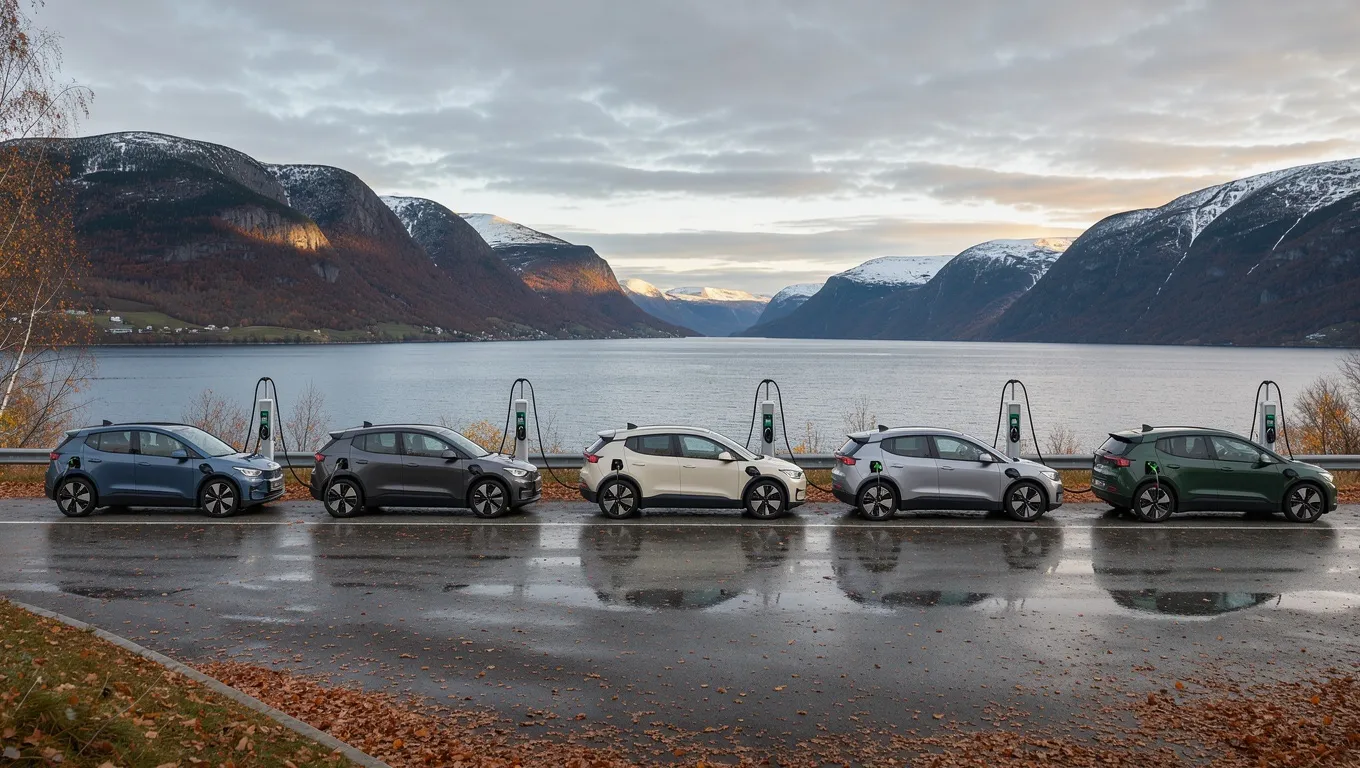
Electric cars made up 98.8% of new car sales in Norway in October, matching September's record. Chinese brands took 22.5% of the market, the highest share they've ever had there, and more than one in five new cars sold.
Norway registered 15,725 new cars in the month, its best October in over 30 years, according to figures from Norway's road traffic information council OFV, published by the Norwegian EV Association. Electric car sales were up 43% on October 2025, while sales of cars with a combustion engine fell by 34%.
Norway's electric car market in October
For anyone wondering what a nearly all-electric market looks like, the top 10 is the answer: every car on it is electric, and it's a mix of familiar European family cars and newer Chinese arrivals.
| Model | October 2026 | 2026 so far |
|---|---|---|
| Tesla Model Y | 1,429 | 17,647 |
| Toyota bZ4X | 725 | 5,570 |
| Volkswagen ID.4 | 553 | 4,926 |
| XPeng G6 | 542 | not in top 10 |
| Audi Q4 e-tron | 535 | not in top 10 |
(Source: OFV, via Norsk elbilforening. 2026 figures run from 1 January to 31 October.)
The Tesla Model Y sold almost twice as many as its nearest rival, but it's behind its 2025 pace, when it reached 27,621 registrations over the year. The Toyota Urban Cruiser, Tesla Model 3, Volvo EX30, Volvo EX40, BMW iX3, Skoda Elroq and Toyota C-HR+ complete the year-to-date top 10.
Chinese brands sold 3,534 cars in October, up from 1,879 a year earlier, and their share rose from 16.9% to 22.5%. Over the year so far they have 17.7%, up from 13.3%. XPeng led them with 932 cars, making it Norway's fifth-biggest brand for the month, with BYD on 816. The XPeng G6 had its best month of the year, and the Changan Deepal S05 its best ever, with 338 sales. Those figures don't include Volvo, which OFV doesn't count as Chinese even though its owner is China's Geely.
Norway is a useful test case for the rest of Europe because it's outside the EU and hasn't added the EU's extra tariffs on Chinese-built electric cars. That lets Chinese brands compete there more directly, with a tax system that already treats all electric cars the same way.
Vans are following more slowly. Electric vans took 68.4% of the market in October, down six points on September but well up on 45.9% a year ago. Electric trucks reached 25%, from 20%.
The VAT change coming in January
A tax change is likely to keep sales high until the end of the year. Norway has been phasing in VAT on electric cars, and this year the 25% rate applies only to the part of a car's price above NOK 300,000 (about €28,850). The government's budget for 2027 proposes cutting that limit to NOK 150,000 (about €14,430) from 1 January. Norway's parliament hasn't voted on the budget yet, but the Norwegian EV Association expects the change to support sales in the final months of the year.
For a buyer, the difference is simple. On a car priced above NOK 300,000 before VAT, the lower limit means VAT on another NOK 150,000 of its price, which adds NOK 37,500 (about €3,600). The government expects the change to raise about NOK 3.8 billion. Parliament has also asked for the remaining exemption to go in 2028, which would mean full VAT on electric cars, subject to approval from the EEA's surveillance body.
The limit has already come down once, from NOK 500,000 to NOK 300,000 at the start of 2026, and electric cars still took 97.6% of sales in the first half of 2026. Next year's sales will show how Norway's market copes with a further cut.
How Norway compares
Ireland is further behind, but moving quickly. Electric cars took 43.7% of its new car market in October, a quieter month for registrations, and 27.74% over the year so far, according to SIMI. That makes them Ireland's most popular choice this year, with EV registrations up 57%, helped by the SEAI grant and VRT relief. Unlike Norway, though, Ireland's top sellers are still mainly European and American: the Volkswagen ID.4, Tesla Model Y, Skoda Enyaq, Tesla Model 3 and Skoda Elroq lead the 2026 table.
The rules differ too. The EU charges extra tariffs on Chinese-built electric cars, the UK hasn't introduced any but is still talking to its European partners, and its Electric Car Grant is based partly on manufacturing emissions. Whether Chinese brands can reach Norwegian levels elsewhere will depend on rules like these as much as on the cars themselves.
(Euro figures use Norges Bank's rate on 4 November 2026 of NOK 10.397 to €1, and are rounded.)